|
|
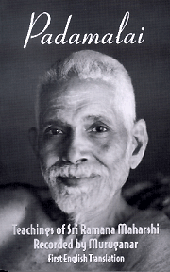
RAMANA
MAHARSHI
PADAMALAI
| TEACHINGS OF SRI RAMANA
MAHARSHI
Recorded
in Tamil by Muruganar | First
English Translation
Translated
by Dr T.V. Venkatasubramanian, Robert
Butler and David
Godman
Edited
and annotated by David Godman
"What is always natural to everyone
is liberation, which is bliss. Bondage is
delusion of mind, a false sensation. The
ego alone is bondage, and one's own true
nature, free of the contagion of the ego,
is liberation. There is no greater
deception than believing that liberation,
which is ever present as one's own nature,
will be attained at some later stage. Even
the desire for liberation is the work of
delusion. Therefore, remain still."
Padamalai is a Tamil work
that contains almost 2,000 teaching
statements by Ramana Maharshi, none of
which has ever appeared in English before.
They were recorded by Muruganar, one of
Sri Ramana's foremost disciples, in
two-line couplets.
David Godman, who has written several
books on Ramana Maharshi and his
disciples, has edited this English edition
of Padamalai. He has arranged the
teachings by subject, and he has added
many supplementary quotations by Sri
Ramana that amplify or explain the subject
matter.
This is a completely new presentation of
Ramana Maharshi's teachings that contains
many statements and ideas by him that have
never appeared in any other book about
him.
396 pages | 22,00 €
15,00 € (slightly damaged) | 550 g
|
|
|
RAMANA
MAHARSHI
HEART
IS THY NAME, OH
LORD
Moments
of Silence with Sri Ramana Maharshi
Foreword
by Vimala Thakar
The Maharshi, Bhagavan Sri Ramana was
drawn to Arunachala hill in his
seventeenth year, after a spiritually
awakening death experience. For the rest
of his life, till the body was shed fifty
years later, he never left his beloved
hill. People from far and near came to his
presence and were spiritually
enriched.
His divine presence continues to be felt
and his universal philosophy attracts an
ever-growing following.
This book is a selection of his teachings
arranged with beautiful full-page
photographs, and is intended to help the
mind turn inward and abide in deep Silence
awaiting each of us.
Oh
Arunachala! In Thee the picture of the
universe is formed,
has its stay, and is dissolved;
this is the sublime truth.
Thou art the inner Self, who dancest in
the Heart as 'I'.
'Heart' is Thy name, Oh
Lord!
108
pages | including 50 photographs | 10,00 €
| 495 g
|
|
|
RAMANA
MAHARSHI
ABSOLUTE
CONSCIOUSNESS
"The seen is not different from the
seer. What exists is the one Self, not the
seer and seen. The seen regarded as Self
is real."
This book contains some of the precious,
direct and profound teachings of Bhagavan
Sri Ramana Maharshi. The book is divided
into three parts. The first part contains
his main teaching, Nan Yar [Who
Am I?], the direct path and
consciousness. The second part concerns
the eternal, unlimited, unchanging
consciousness. The final part consists of
Self-enquiry, ego, mind, rebirth and other
subjects. Through Self-enquiry, one is
able to bypass the endless thought
pressures and remain in the the natural
state of happiness and Self-knowledge.
There are also about 50 photographs of
Bhagavan Ramana.
200 pages | 7,00 € | 255 g
|
|
|
RAMANA
MAHARSHI 3
VOLUMES
THE
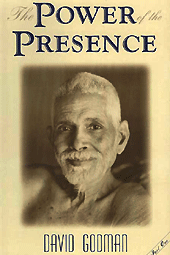
POWER OF THE PRESENCE | PART 1
***
temporarily unavailable
***
Transforming
encounters with Sri Ramana Maharshi
Edited
by David Godman
What was it like to live with and be
guided by Sri Ramana Maharshi, one of the
greatest sages that India has ever
produced? In Part One of this new
anthology eight devotees narrate their
personal stories that chronicle in detail
how Bhagavan's power and grace had
transformed their lives. The devotees are
Rangan, Sivaprakasam Pillai, Akhilandamma,
Sadhu Natanananda, N. R. Krishnamurti
Aiyer, Chalam, Souris and Swami
Madhavatirha. Most of these accounts have
never before appeared in English. This
book shows the many different
relationships Bhagavan had with devotees
who had widely differing backgrounds and
who in many cases surrendered their lives
to him.
"Going through these accounts again,
some of which I have not read for more
than tens years, I can only marvel at the
awesome, effortless power that flowed from
Bhagavan and transformed the lives and
hearts of those who were pulled into his
orbit. When I first came across some of
these stories, I felt as if I had
discovered buried treasure. Now, many
years later, I feel that the time is now
right to put this treasure into the public
domain so that everyone who feels drawn to
Sri Bhagavan can have a share in
it."
David
Godman
294 pages | 17,00 € | 425
g
|
|
|
RAMANA
MAHARSHI
THE
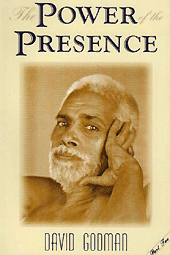
POWER OF THE PRESENCE | PART 2
***
temporarily unavailable
***
Transforming
encounters with Sri Ramana Maharshi
Edited
by David Godman
In Part Two of this new anthology six
devotees narrate their lengthy
first-person accounts of how their lives
were transformed by Ramana Maharshi. The
devotees are Kunju Swami, Muruganar, T. P.
Ramachandra Iyer, Chhaganlal V. Yogi,
Lakshmana Swamy and Viswanatha Swami.
"I was a learned fool. My flawed
mind knew nothing till I came to dwell
with Him whose glance filled my heart with
the light of awareness. Dwelling in that
gracious state of peace, whose nature is
holy silence, so hard to gain and know, I
entered into union with the deathless sate
of knowledge of Reality."
Muruganar
269 pages | 17,00 € | 375
g
|
|
|
RAMANA
MAHARSHI
THE
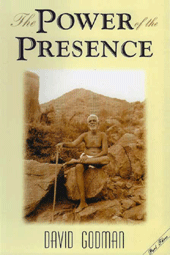
POWER OF THE PRESENCE | PART
3
Transforming
encounters with Sri Ramana Maharshi
Edited
by David Godman
In this third and final volume, David
Godman has included an anthology of the
lives and experiences of a number of
outstanding devotees of Ramana Maharshi
who never recorded their own stories.
These devotees include Ramanatha
Brahmachari, Mastan, Lakshmi the cow,
Echammal, Mudaliar Patti, Krishna Bhikshu,
Wolter Keers, G.V. Subbaramayya and Natesa
Iyer. They all exemplify the highest
quality of devotion to their Guru. Also
included is a chapter by Lakshman Sarma
that contains an excellent summary of many
aspects of Bhagavan's teachings. This text
is written in verse form and contains many
of Bhagavan's direct quotations.
"The transforming glance of the sage
of Arunachala penetrated my heart in a way
that I, a worthless soul without true
love, was redeemed completely. Through its
action I was transformed into the state of
Shiva."
Ramanatha
Brahmachari
346 pages | 17,00 € | 475
g
|
|
|
RAMANA
MAHARSHI
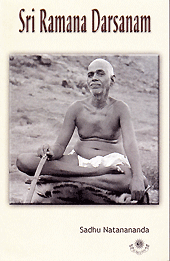
SRI
RAMANA
DARSANAM
By
Sadhu Natanananda
Translated by Dr Venkatasubramanian |
Edited by David Godman
"When the glittering sun appears, no
stars are seen. Similarly, when my
godliness arose, no thought appeared."
Sadhu Natanananda was a
distinguished Tamil scholar and devotee
who first met Bhagavan in Skandashram. His
collection of dialogues with Bhagavan
– Upadesa Manjari in Tamil and
Spiritual Instructions in English
– has appeared in several editions of
Bhagavan's own Collected Works.
Sadhu Natanananda also edited Vichara
Sangraham
[Self-Enquiry] in both the
essays and question-and-answer formats.
Bhagavan also gave him the job of
arranging the verses of Guru Vachaka
Kovai, Muruganar's authoritative
compendium of Bhagavan's teachings.
This work, Sri Ramana Darsanam, is
a penetrating analysis of Bhagavan's life
and teachings, illustrated by many
quotations and stories that have never
appeared in English before. Also included
are two long poems that Natanananda wrote
in the 1950's which explain key points of
Bhagavan's teaching and give intimate
details of Natanananda's own inner
experiences.
146 pages | 11,50 € | 275
g
|
|
|
RAMANA
MAHARSHI
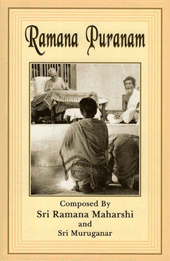
RAMANA
PURANAM
Composed
by Sri Ramana Maharshi and Sri
Muruganar
Edited
and Translated by Dr
T.V. Venkatasubramanian, Robert
Butler and David
Godman
In the 1920's and 30's Muruganar wrote
Sri Ramana Sannidhi Murai, an
anthology of devotional poems in praise of
Bhagavan that was modelled on the
Tiruvachakam of Manikkavachagar.
While he was composing, in Bhagavan’s
presence, the poem that would eventually
be called Ramana Puranam, he took a
break to go out and think about the title.
When he returned to the hall, he was
astonished to discover that Bhagavan had
not only named the poem Ramana
Puranam by writing this title on every
page of the manuscript, he had also
completed it by composing and adding about
300 extra lines. In his contribution to
Ramana Puranam Bhagavan not only
continued with some of Muruganar’s
own devotional themes, he also expanded
the range of the work by including many
lines that summarised key aspects of his
own teachings, particularly ideas that he
had written about in Ulladu
Narpadu. This work, larger than any
of Bhagavan's other poetical works, has
languished in an undeserved obscurity for
many decades, accessible only to those few
who knew enough literary Tamil to read the
original.
104 pages | 11,50 € | 215
g
|
|
|
RAMANA
MAHARSHI
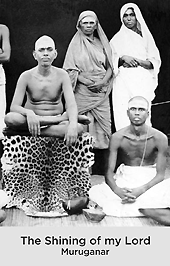
THE
SHINING OF MY LORD
Selected Verses from Sri Ramana Jnana
Bodham and Other Muruganar Texts
Composed by Muruganar
Translated
by Dr T.V. Venkatasubramanian, Robert
Butler and David
Godman
Edited
and annotated by David Godman
When Muruganar passed away in 1973, the
task of preserving and organising the
approximately 20,000 verses of his that
had yet to be published fell to Sadhu Om,
his literary executor. Over the next
decade he edited this body of work,
eventually bringing it out in a series of
nine Tamil volumes entitled Sri Ramana
Jnana Bodham. This title can be
translated as The Experience of Jnana
Bestowed by Sri Ramana, or
Experiencing the Jnana that is Sri
Ramana.
Padamalai, a collection of
Bhagavan’s sayings recorded by
Muruganar, is the only substantial part of
Sri Ramana Jnana Bodham that has so
far appeared in English. It was published
in 2003 and is available above.
The Shining of my Lord is an
anthology of just over 1,000 Muruganar
verses that have primarily been taken from
the first eight volumes of Sri Ramana
Jnana Bodham. They have been selected,
translated and edited by T.V.
Venkatasubramanian and David Godman. The
book also includes a long introductory
biography that chronicles Muruganar’s
association with Sri Ramana Maharshi and
the literary works that were the fruit of
that relationship.
Unlike Padamalai, where the
emphasis is on recording Bhagavan’s
teachings, the theme of this new book is
the state of liberation that Sri Ramana
bestowed on Muruganar. In verse after
verse Muruganar attempts to describe the
state of the Self and the grace of his
Guru, Sri Ramana, which enabled him to
become established in it.
279 pages | 16,50 € | 515
g
|
|
|
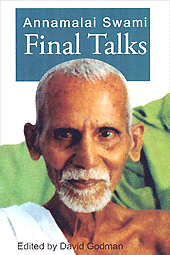
ANNAMALAI
SWAMI
FINAL
TALKS
Edited
by David Godman
"Forgetfulness or non-forgetfulness
is not a part of your destiny. It is
something you choose from moment to
moment. That is what Bhagavan [Ramana
Maharshi] said. He said that you have
the freedom either to identify with the
Self and have the understanding that the
body is performing its predestined
activities, animated and sustained by the
power of the Self, or you can identify
with the activities of the body and the
mind, and in doing so forget the Self. If
you choose the latter course, don't blame
God or God's will, or predestination. God
did not make you forget the Self. You
yourself are making that choice every
second of your life."
Annamalai Swami came to Ramana
Maharshi in 1928 and spent nearly all of
the following ten years serving him,
initially as his attendant, and
subsequently as the supervisor of all the
building projects that Sri Ramanasramam
undertook during this period.
In 1995, the year that Annamalai Swami
passed away at the age of eighty-nine,
audio recordings were made of the
dialogues that he held with those coming
to him for spiritual instructions between
March and October. This small, powerful
book is therefore an edited record of what
turned out to be the last six months of
Annamalai Swami's teaching career. His
teachings were uncompromising,
straightforward, and rarely deviated from
a solid core of advice that he himself had
been given by his own Guru. However, they
were delivered with a force and a gentle
humour that was irresistibly
attractive.
99 pages | 11,50 € | 240 g
|
|
|
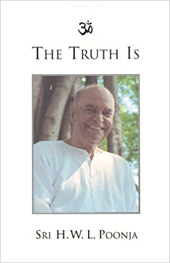
H. W.
L. POONJA
THE
TRUTH IS
This is a collection of spontaneous
discourses, from 1990 to 1996, between
Poonjaji and visitor's coming to him for
guidance. Through his responses, Poonja
reveals thousands of ways to help us
enquire into who we really are – pure
love and consciousness, the totality of
existence. Bringing our awareness into the
infinity of the moment, we are finally
ready to surrender to the wisdom of our
Truth.
Satguru is within your own Self and
nowhere else.
Your Satguru dwells in your heart
and in the heart of all beings.
Since you don't understand his
language,
by Grace he takes a form to point you
within.
The Maharshi often would say,
"The real Guru is within."
Question : Why am I so
insecure?
Papaji : Because you are depending
on something that is not secure itself and
therefore you cannot be happy!
553 pages | including 26
photographs | 29,00 € |
850 g
|
|
|
H. W.
L. POONJA
WAKE
UP AND ROAR
"For an enlightened being there is no
consideration of past or future. No
consideration is given to the fruits of
action. Rather, action is taken in each
moment from Emptiness. The fruits will
take of themselves."
This book introduces to the world an
extraordinary development. Full awakening
is possible here and now for everybody,
regardless of background, practice or
personal circumstances. This possibility
is the teaching and transmission of Sri
H.W.L. Poonja. Inspired by his teacher,
Ramana Maharshi, Poonjaji leads one on to
the Source – the Self, through
conversations, in the form of questions
and answers. The approach is simple and
direct.
Many people have experienced glimpses of
the Truth through psychedelics or
meditating or unexpected moments of bliss.
Yet, because of incorrect understanding,
these moments usually get incorporated
into the ego as just another experience.
There is an unspoken belief that it is not
possible to be totally awakened in this
lifetime. Wake Up and Roar
announces the possibility of true freedom
now. No postponement or practice
necessary! This is Sri Poonjaji's gift to
the world.
''The Self contains everything.
There is nothing apart from it. This is
why you can call it Emptiness. There is
nothing beyond Emptiness.''
320 pages | including 25
photographs | 25,00 € |
630 g
|
|
|
H. W.
L. POONJA
READ
AN EXCERPT
THE
FIRE OF FREEDOM
Satsang
with Papaji
Edited
by David Godman
"If someone tells you something, don't
accept it because no teaching has so far
touched the Truth. This much I will tell
you. No one ever spoke the Truth. No word
has ever been coined to present
it."
Sri H.W.L. Poonja, known in his later
years by the title 'Papaji', has been one
of the most influential spiritual figures
of modern times. A disciple of the great
South Indian Guru Sri Ramana Maharshi,
Papaji brought the teachings of his own
master to new generations of seekers in
the decades that followed Sri Ramana's
passing away in 1950.
After an incident-packed and peripatetic
life that took him all over the world,
Papaji finally settled down in Lucknow,
North India, where he gave daily satsangs
throughout the 1990's. His teaching,
succinctly and trenchantly expressed in
this completely new collection of teaching
dialogues between Papaji and visitors who
came to see him in Lucknow in the middle
of 1991. At that time only about fifteen
people would come each day, and all the
satsangs were held in the living room of
Papaji's house.
In these conversations Papaji explains the
practical teachings of his master, Ramana
Maharshi, in a simple and forceful way. As
he engages his visitors in discussions
about the nature of spiritual freedom and
the means by which it can be discovered,
he is always looking for an opportunity to
take his questioners back to the source of
their minds so that they can find out for
themselves, by direct experience, what he
is trying to show them.
"You have to wake up yourself; you
have to see for yourself. The senses are
not needed, nor are the eyes. The eyes
cannot see it; the mind cannot understand
it; the intellect cannot grasp it. None of
these will accompany you. You have to be
alone without these things. You have to
proceed alone. None of the five elements
will accompany you. You will go alone to
meet this situation, but what it is, no
one knows. "
291 pages | including 20 colour
photographs | 18,00 € |
445 g
|
|
|
H. W.
L.
POONJA 3
VOLUMES
NOTHING
EVER HAPPENED
A
three-volume biography of Poonjaji
By
David Godman
"Nothing has ever happened. Nothing
has ever existed. The world never came
into existence or disappeared from it.
That place is my real home. It is where I
always am. One can say this with authority
only when one abides in that ultimate
Place."
A massive biography of Papaji, a disciple
of Ramana Maharshi and one of the most
influential advaitic teachers of modern
times. In addition to the biographical
narrative that spans more than eighty
years of his action-packed life, there are
teaching dialogues, extensive extracts
from Papaji's diaries and letters, along
with many accounts by devotees who were
utterly transformed by him.
The first volume covers the early years of
his life, his meeting with his master,
Ramana Maharshi, and other teachers as
well as his teaching and encounters with
South Indian devotees. The second volume
begins with his life in Rishikesh in the
60's and 70's. It moves on to his foreign
travels and has teachings dialogues that
took place in the 70's. The third volume
is about his meetings with devotees in the
70's and 80's. It contains numerous
extracts from his personal diaries and
detailed explanations about the
Guru-disciple relationship. In Sri
Poonja's presence and through his dynamic
transmissions, countless people have been
made aware of the impersonal reality that
underlies the world and all phenomenal
experiences. This is the definitive
account of Papaji's life.
1297 pages | 29,00 € | 2100
g
|
|
|
H. W.
L. POONJA
PAPAJI
| INTERVIEWS
Edited by David Godman
Papaji: Interviews contains diverse
interviews that foreign devotees and
journalists had with Papaji between 1990
and 1993. All of them give an excellent
introduction to Papaji's teachings. The
book also contains a fifty page biography
of Papaji, contributed by the editor,
which focuses on Papaji's early life and
his relationship with Ramana Maharshi.
Question: Is there not something a
person can do in the way of spiritual
practice in order to prepare himself or
herself?
Papaji: This is postponement, no?
Postponement. One who says, "I have to
prepare myself" is deceiving himself,
fooling himself. Whatever can be done
tomorrow can also be done
today.
305 pages | 16,00 € | 400
g
|
|
|
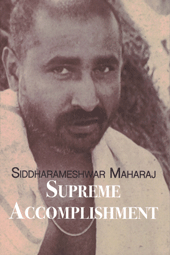
SIDDHARAMESHWAR
MAHARAJ
SUPREME
ACCOMPLISHMENT
Lectures
on Non-Duality
Siddharameshwar Maharaj was born in 1888
in Pathri, in the state of Maharashtra.
His teacher, Bhausaheb Maharaj, taught
meditation as a means of attaining
Self-knowledge. Following his full
understanding of himself, Siddharameshwar
Maharaj for his part developed a more
direct teaching which he called the "path
of knowledge" or "path of the bird". The
basis of this teaching is the philosophy
of non-duality which states that in
Reality there is only the One and nothing
else.
Siddharameshwar Maharaj left his body in
1936, at the age of 48, after leading many
disciples to ultimate understanding. Among
them Nisargadatta Maharaj and Ranjit
Maharaj, contemporary masters who have
both adapted their teaching to a wider
audience of Indian but also Western
disciples.
Each of the 23 chapters of this book
corresponds to a discourse or commentaries
on texts [Yoga Vasistha or
Dasbodh] given for the most
part in 1928.
"When the power of the Sadguru is
with you, what control will laws or the
accounts of destiny have over you? You
will have become the Lord and all your
outstanding accounts of sins and virtues
will not remain. Understand, you are the
King! Even when you go out hunting, still
you are the King. You are that God of the
gods, so why do these notions like
circumstance, auspicious and inauspicious
remain? You are that Lord, this whole
world is His house and He has built it out
of Himself and for His own pleasure. For
Him there are no laws, just total
freedom!
There is one truly unavoidable principle
and that is, you become whatever you
believe you are. Therefore, do not forget
your own Self. 'I am that Supreme Self and
everything gets accomplished through the
authority of my knowledge.'
Without this conviction, you turn this
knowledge 'I am' into useless, empty
promises. Therefore increase your
Self-conviction every moment and do not
descend from the King's throne! When He
sits upon His throne, His sovereign
authority is carried out effortlesslyand
naturally, and because you are Brahman,
there will be no law for you. No laws are
without Him, but He is above and beyond
and exempt from His laws.
If you cherish and nurture this conviction
that you are the Self, this conviction
will keep growing stronger and stronger.
If you treasure this understanding offered
to you by your guru, or Self, for they are
both the same, you will be
liberated."
224 pages | 18,50 € | 430
g
|
|
|
SIDDHARAMESHWAR
MAHARAJ
AMRUT
LAYA | VOLUME
1
The
Spiritual Science of Self-knowledge
The
Stateless State | Discourses on
Dasbodh
"Detachment is absence of even a
single desire. This leads to fearlessness.
Otherwise, there is no freedom from fear
for you. One should not depend on others,
as in the case where one thinks : 'If I do
not get anything to eat I will die.'
Desire for the bliss of the Self, is
desire for the bliss within. People who
hoard millions and then go about telling
others the knowledge of Reality do not do
good to themselves, instead they commit
fraud."
Siddharameshwar Maharaj, the master of
Nisargadatta Maharaj and Ranjit Maharaj
changed his own master's traditional way
of teaching through meditation
[pipilika marg] called the ant's
way into the bird's way [vihangam
marg], which uses thinking to overcome
ignorance. He preached the more direct
Bird's Way in very simple and lucid
language. Siddharameshwar Maharaj also
wanted the understanding of final Reality
to be accessible to all, so he refused to
use complicated or technical language and
used examples taken from daily life. He
taught that the sat-chit-ananda
stage [the source of knowledge or
consciousness] is still an illusion.
Reality is beyond both ignorance and
knowledge. He first taught by way of
knowledge and then told his disciples to
renounce the world, because renunciation
without knowledge has no value. Finally,
he told them to renounce the renunciation
because that is also ego based. This
teaching enabled them to understand that
the world starts from 'zero'
[knowledge] and ends in 'zero', so
when it is nothing, what is there to
renounce? One then re-enters the illusory
world convinced that it is nothing but
'zero'.
Written in the 17th century by Swami
Samarth Ramdas, Dasbodh captures
the essence of Upanishadic thought: the
Reality of the all-pervading Oneness. The
essential merit of Amrut Laya lies
in the fact that Siddharameshwar Maharaj
interpreted the seemingly esoteric and
abstract teachings of Dasbodh in a
lucid manner to facilitate understanding
by even those without formal education.
This book is ideally aimed at the seeker,
who having tired of the transience of this
phenomenal existence, strives to know the
original cause of his creation.
200 pages | 10,00 € | 265
g
|

|
|
SIDDHARAMESHWAR
MAHARAJ
AMRUT
LAYA | VOLUME
2
The
Spiritual Science of Self-knowledge
The
Stateless State | Discourses on
Dasbodh
"All pride must vanish. 'I am the
body, my wealth, my son, I am a person
with status, my wife, my relatives'. So
long as all these ideas exist, there
cannot be real knowledge. After
realisation of the Self, the aspirant
regards his master as the greatest of all.
He feels that he belongs to the
master."
This volume is a companion to the first
volume entitled Amrut Laya, The
Stateless State. That first volume
contains the the great work of distinction
written by Siddharameshwar Maharaj
entitled Master Key to
Self-Realisation as well as the
transcribed notes from 50 lectures given
by Siddharameshwar Maharaj on various
themes from Dasbodh.
This second volume of Amrut Laya
contains transcribed notes of 88
additional lectures. This text is a great
treasure-house of spiritual enlightenment
and "Knowledge of Self" that has been
imparted by Siddharameshwar Maharaj. In
this book, he elaborates on various
spiritual principles that are presented in
selections from three main classic texts :
Dasbodh, Yoga Vasistha and
Eknathi Bhagawat. He gives details
explanations of many principles of
vedantic philosophy in a clear, simple
language. Most importantly he describes
the nature of the Self [Atman],
Brahman, dispels ignorance with knowledge
[jnana], and then tells us to cast
off even that knowledge. He directs the
reader to that indescribable Parabrahman
which is our true form.
"Spiritual knowledge, unsupported by
worship is baseless. If there is no
devotion, there is no knowledge. Devotion
is the mother of knowledge. Without the
master's grace, there is no knowledge.
When will the master's grace flow? Only
through steadfast devotion. Then, even mud
will turn into gold. The Satguru is your
protector. Why bother about others when
the Satguru is your guardian?"
151 pages | 10,00 € | 265
g
|
|
|
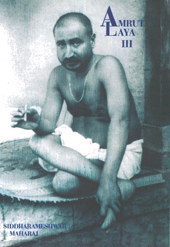
SIDDHARAMESHWAR
MAHARAJ
AMRUT
LAYA | VOLUME
3
A
Collection of Talks
"All this belongs to Paramatman. Let
things take their own course, what is it
to me? Whatever happens, whatever is lost,
it is none of my concern."
This third volume of Amrut Laya
contains transcribed notes of 68
additional lectures between 1928 and 1930.
These teachings lead one directly to the
source of one's being.
"There are only two states in this
world: existence and non-existence. It is
you who continues to believe in the
existence of the 'dream-mind'. Keep
telling yourself that it does not exist
and watch it melt away. The same goes for
the creation, the world. What is the harm
in calling it 'dust'? If you call it
'dust', all concepts will collapse. By
breaking down the walls of the mind, you
become Parabrahman himself. You will no
longer consider yourself to be a small
creature. Your search for God and
happiness ends. You are the Ultimate,
Parabrahman."
194 pages | 13,00 € | 300
g
|
|
|
RAMAKANT
MAHARAJ
READ
AN EXCERPT
SELFLESS
SELF
Talks with Sri Ramakant
Maharaj
"Invite your attention towards
yourself seriously and you will come to
know that there is no God except
yourself."
Sri Ramakant Maharaj is a direct disciple
of the late Nisargadatta Maharaj and spent
19 years with him. For over a decade at
the ashram in Nashik Road, Ramakant
Maharaj has been meeting with devotees
from around the world to clear their
doubts about Reality. His teachings are
radical and direct, cutting through all
the illusory layers of concepts until the
conviction "I am nothing" is firmly
established. From this, the true knowledge
"I am everything" naturally shines
forth.
"You have arrived. You have arrived
at the destination because you are Final
Truth, you are Ultimate Truth.
Unfortunately, you are not accepting the
Ultimate Truth, and that is the problem.
The same principle, the same thing is
being placed before you again and again,
in different words, different sentences,
using different stories, but the principle
is one. Except your Selfless Self, there
is no God, no Brahman, no Atman, no
Paramatman, no master. You are your own
master. You are your own Paramatman. But
since you are measuring yourself in the
body-form, you are unaware of your
Ultimate Truth. You have to stand on your
own feet. You are not handicapped. All
this body-knowledge has made you view
yourself as disabled, disadvantaged,
incapable. The master says: "You are not
disabled at all. You can walk using your
own legs. Remove these artificial limbs.
You have to learn to stand on your own two
feet." You must have courage! It is a lack
of courage and a lack of confidence that
leads to problems : "Oh I am weak." Jump
in and swim! This is the only way you can
be strong. The swimming teacher throws the
child into the water, and then, next
moment, he is swimming. His confidence
grows. The master is creating confidence
in you."
502 pages | 23,30 € | 780
g
|
|
|
RANJIT
MAHARAJ
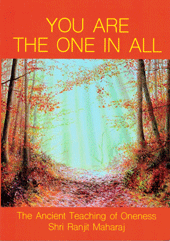
YOU
ARE THE ONE IN ALL
An
Ancient Teaching of
Oneness
"Only the one who can mentally leave
everything can understand. The one who
holds on will never understand. The
serpent bites the one who holds it, not
the one who leaves it alone. All the
objects of the world bite you because you
hold on to them. A realised person leaves
things alone, so he is untouched. For him
there is no joy nor sorrow, no sin nor
virtue, nothing auspicious nor
inauspicious, no birth nor death, no
bondage nor liberation. He is the One in
many. He is everywhere; there is nothing
else other than him."
Ranjit Maharaj was born in Mumbai, India,
in 1913 and was a disciple of
Siddharameshwar Maharaj and co-disciple of
Nisargadatta Maharaj. He always attributed
his Self-realisation to the greatness of
his master. He began to teach in 1983, and
over the years, many seekers came to his
small room in Mumbai to have him answer
their many questions on Reality.
Maharaj's teaching is direct and straight
to the point. As long as there is a sense
of duality, no happiness is possible.
Duality comes when you identify with the
body. The "I am the body" thought gives
birth to the ego, the self, which is an
isolated and separate entity perpetually
seeking security. There is a constant fear
of insecurity which is inbuilt in duality,
and so, true happiness can never be
attained until duality has been
rejected.
Prior to the "I am the body" thought, you
are "one without a second". In this
oneness state there is no fear, no
insecurity, no separateness, no isolation
and no duality. It is beyond consciousness
and unconsciousness. That is your true
nature. It is the Stateless State, the
embodiment of exceptional happiness and
peace. So, reject duality and accept
Oneness to experience ever-lasting
peace.
This book, rather than simply being a
collection of Maharaj's discourses, also
gives a glimpse of what it was like to be
with Maharaj each day. Maharaj left his
body in 2000 and his teachings live on in
the hearts and minds of his disciples
worldwide.
330 pages | 19,20 € | 570
g
|
|
|
RANJIT
MAHARAJ
ILLUSION
VERSUS REALITY | PART
1
Dialogues
with Ranjit Maharaj on the Stateless
State
"Death is to the body. You are not
the body. What comes must go, but you are
ever there. Electricity doesn't worry if a
bulb goes off. Put in another bulb and you
get the light. You are everywhere. You are
the source of everything. How can you die?
Master makes you He [Reality], no
death for you. I still go ahead and say
this is a dead body at the moment. Power
is connected, it speaks. In a fraction of
a second power can be disconnected. Be He,
that's the main point."
Between 1996 and his demise in 2000,
Ranjit Maharaj was invited to Europe and
America several times to answer seekers'
questions about Reality. This book is a
compilation of dialogues on the 'Stateless
State' which took place in various
countries.
Ranjit Maharaj met his master,
Siddharameshwar Maharaj at the age of 12.
His teaching, given in the spirit of his
master's, makes no concession for the ego
and aims only at pure Self-knowledge and
freedom.
220 pages | 10,00 € | 325
g
|
|
|
RANJIT
MAHARAJ
ILLUSION
VERSUS REALITY | PART
2
Dialogues
with Ranjit Maharaj on the Stateless
State
"One who goes to the depth of the
ocean gets the pearl. Go to the depth of
yourself and He [Reality] remains.
One who gets the understanding doesn't
feel anything. Whatever happens, let it
happen, it's okay."
Ranjit Maharaj was born in Bombay on
January 4th 1913. In 1924, at the age of
12, he met his master Siddharameshwar
Maharaj, a great unknown master of the
age. Ranjit Maharaj only began teaching in
1983 at the age of 70 when increasing
numbers of seekers kept showing up at his
door. The teaching of Ranjit Maharaj is in
the continuity of his master's, with no
concession for the ego and aiming only at
pure Self-knowledge and freedom. This book
gives a straight forward and comprehensive
knowledge of Reality in the form of
questions and answers which took place in
Bombay and Europe from February 15th, 1999
until July 26th, 2000, less than four
months before he passed away.
215 pages | 10,00 € | 270
g
|
|
|