|
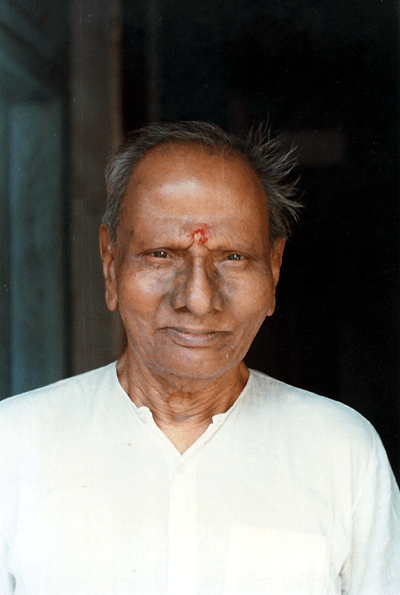
A
GREAT
MAHARASHTRIAN
JNANI
|
Let
there be peace and love among all beings of the universe. OM
Shanti, Shanti, Shanti.
|

|
|
NTRODUCTION
|
|
Though a
Maharashtrian myself it was a matter of great shame
for me that I had not known of this great
Maharashtrian jnani [a Self-realised
being], Nisargadatta Maharaj till March
1992.
I was waiting for Bhagavan's morning darshan as
usual at Brindavan ashram. A friend of mine sitting
next to me was pouring over the pages of a fairly
bulky book. I gave a sly glance at the book
unwilling to disturb him. I found the title of the
book I Am That. This roused my curiosity
about the author's name.
|
|
I found the
author to be Maurice Frydman whose name sounded
very familiar to me. I was a frequent visitor to
Sri Ramanasramam [ashram of Ramana Maharshi at
Tiruvannamalai, Tamil Nadu] in the early years
between 1944 and 1948, when I was a judicial
officer there. I had seen him there though I had
not talked to him.
My friend somehow sensed that I was anxious to look
into the book, and to my great joy handed me the
book. I poured over a few pages at random and found
precious pearls of wisdom on the few pages I
happened to browse.
This is the genesis of this book, the seeds of
which were sown about a year ago. I had no
intention whatever of writing this book. My
ceaseless remorse at not knowing about the
existence of Maharaj earlier haunted me. Added to
this was a sense of pride that he belonged to my
community, the Maharashtrians.
Nearly about a lakh of Maharashtrians live
scattered in places like Madras, Bangalore,
Tanjore, North Arcot and Krishnagiri district and a
few other places. A strange urge to write about
this great jnani took possession of me. I was
anxious that I should make him known to the people
of the South, Who were utterly unaware of his
existence. They could scarcely believe that such a
great soul lived in a bye-lane in the city of
Bombay, avoiding publicity. It sounds somewhat
paradoxical that people in the Western world knew
more about him than his own countrymen in India. We
have ourselves to blame for this situation.
If by publishing this book I have aroused some
interest in him in the people of the South and
dispelled the unpardonable ignorance about him, I
will deem it, that I have achieved something. May
the ever merciful Maharaj forgive us in his
infinite grace, and make us aware of his sublime
teachings.
|
|
|
It
remains for me to express my gratitude to all my
friends and well-wishers who were anxious that I
should publish this book for the benefit of all
concerned. I must first thank my very good friend
Mr. Krishnamurthy who was instrumental in typing
the manuscript for this book. He did it in such a
perfect way that not a world needed correction.
I must next thank Mr. Hans Bearholm and his wife
Lilian from Denmark, a highly spiritual persons,
for all the moral support they gave in encouraging
me to write about this great jnani. Next I must
thank other friends and well-wishers who took a
keen interest in the publication of this book. I
must also thank my good friend Mr. C.S.
Ramakrishnayya of the Gita Press.
G.K. Damodara
Row
|
|
Vanamali
Mansion, 10th lane, Khetwadi in Bombay became a
landmark for many persons who were seekers of the
spirit. Here lived Nisargadatta Maharaj, a great
jnani in relative obscurity, in the early years of
his life. He was running a small beedi
[cigarette] shop offering a variety of
hand-rolled tobacco, which poor people smoke. In
fact, Maharaj himself was a chain smoker.
It is to the credit of late Maurice Frydman that he
discovered Maharaj in his wanderings in quest of a
Guru. He visited Sri Ramanasramam and Ganeshpuri
[ashram of Nityananda] and other spiritual
centres until he came to Bombay having heard about
Maharaj. With some difficulty he found the lane
where Maharaj lived. He was very intrigued that a
great soul like Maharaj should live in such squalor
and stench in a bye-lane in Bombay instead of in
the Himalayas. Maharaj was a pious man dressed in
simple clothes, and steeped all the time in
meditation and Atma vichara [Self-enquiry].
The surroundings in which he lived did not in the
least bother him. He lived aloof in his loft room,
totally detached from the noisy world around.
Visitors, both foreign and Indian, sought his
company. It was an interesting sight to see
gleaming Mercedes cars glide gracefully with their
rich owners in search of N°10 Khetwadi
Lane.
It is said that Maharaj refused to talk about
himself and such information as could be got was
only from the early devotees, most of whom were
ordinary poor people who used to go to the shop to
purchase beedis. During the course of the purchase,
Maharaj used to draw them into conversation as
shopkeepers often do. The peculiarity of Maharaj
was that he would speak mainly on adhyathmic
subjects and there will be no idle gossip as is the
wont of poor villagers. He never used to encourage
it with the result there used to be a small band of
earnest seekers standing in front of the shop
listening in awe to the pearls of wisdom that fell
from his lips. It was indeed an unusual sight in
those days to see persons who came to purchase
beedis, stay for hours listening in rapt attention
to Maharaj. Maharaj explained great truths in very
simple language. Some of the old people living in
the locality were almost daily visitors to his shop
and were mesmerized by his talks and would not
leave him until they were compelled to go, and
attend to their daily avocations.
From the available materials we are able to gather
that Maharaj was born on a full moon day in March
1897. His birthday coincided with the auspicious
day of Hanuman Jayanthi [birthday] and he
was therefore named as Maruti. His childhood was
spent in a village called Kandalgaon, a short
distance from Bombay. It is said that his father
moved to that village at the time of the plague.
When somebody who was anxious to know about the
date of birth of Maharaj, persisted in asking him
about it, Maharaj replied bluntly that he "was
never born" – a highly abstruse philosophical
statement which most of us cannot understand.
Thinking of his declaration deeply, one is led to
think that Maharaj referred to the Unborn, undying
Self [Atman] and not to the body. Anyway,
many of his devotees left it at that and did not
try to find out the exact date of his birth.
In a reminiscent mood, Maharaj used to say, "I
remember being carried on my father's shoulders
which I greatly enjoyed". His father was a poor
agriculturist and died in 1915. As the income of
the family was found insufficient, the family had
to go back to Bombay to earn their livelihood.
Maruti joined a private firm as a clerk, but he had
to leave it because of his independent temperament.
He often used to say, "Better one day of
independence than a lifetime without freedom".
Being a Maharashtrian by birth and belonging as he
did to the great Shivaji's clan, his view of life
is not surprising.
Maruti grew up almost without education. As a boy,
he tended cattle, worked in the fields with his
father and was a real son of the soil. His
pleasures were equally simple. But it is said by
people who knew him as a young man that he had an
inquisitive mind, anxious to know about the
mysteries of life, its pleasures and sorrows.
Maruti started a business venture in selling beedis
in a shop owned by him in Khetwadi Lane. Luck
smiled on him and he soon became the owner of eight
more shops. Then he got married and had four
children.
Though his business was prosperous and the life was
comfortable, a vague sense of something missing in
his life haunted him. He sought the help of his
learned brahmin friend, Vishnu Gore who kindled in
him questions regarding the world outside, man and
God. Then he befriended another friend, Yashwanth
Rao, who took him to the great and holy
Siddharameshwar Maharaj, a realised soul, who
initiated him into the mysteries of life, God and
karma and gave him a mantra [sacred words or
syllables].
This was the turning point in his life and he took
Sri Siddharameshwar Maharaj as his Guru and clung
to him till his Guru attained Mahasamadhi in 1936.
The following year, Maruti suddenly decided to
abandon his family and also his prosperous
business, and wandered about aimlessly visiting
temples and places of religious interest. His mind
was restless. He travelled north, determined to
spend his time in the Himalayas and never to return
home. It is said that he walked barefoot in the
Himalayan region. There he happened to meet a
fellow-disciple of his Guru who told him that such
wandering was of no avail and was really not
necessary for a spiritual aspirant. He suggested
that Maharaj should go back home and live an active
life as a house holder. He advised selfless service
to the poor which was far more meaningful.
After deep thought Maruti returned back to Bombay.
He found all his shops taken away except one, but
he was not in the least perturbed and got
reconciled to the situation and calmly decided that
one shop was enough for his worldly needs.
After some time when his son was able to look after
the shop, he retired to his small loft room in the
house, which later became an ashram to the
devotees, both Indian and foreign who came to him.
He lived in this small room, till his final Nirvana
in 1981. It is of some importance to note that he
did not yield to the persuasions of some of the
rich Bombay devotees who owned palatial residences
with marble flooring, to come and stay with them.
He refused their request as only a jnani would and
continued to live in his small loft room in the
lane.
|
|
Maharaj used to
get up at 4 A.M. It is said that he used the public
toilet in the street opposite to his residence,
sometimes, not minding the stench emanating from
such toilets, especially in Bombay bye-lanes.
We have to linger here and spend some thought on
his courage and sense of detachment in using a
public latrine which is commonly used by all poor
folk living in the congested locality. He bathed in
the kitchen as there was no bathroom.
Persons who have some knowledge of these dirty
public latrines with unbearable stench associated
with them should ponder over his product in
refusing the luxury of marble floors and posh
bathrooms and preferring to be "himself" and live
like a monk in a cell in his very small apartment
with no relative comforts. Except for a loft room
which can hardly accommodate 20 persons to which he
escaped when devotees, both foreign and Indian
came, there was hardly any decent accommodation in
the modern sense. Devotees who have visited Maharaj
often have told me that he was totally dead to his
surroundings. If foreigners could come all the way
from their country and hunt out the obscure 10th
lane in the Khetwadi area, unmindful of the dirt
and squalor, it only shows their genuine interest
in Maharaj.
Maharaj did not wear saffron clothes or beads as
sadhus [wandering renunciates] do. He had
no particular pose at all. He was a humble house
holder who dressed in ordinary clothes like the
poor people in the locality. When we think of it,
it is difficult to understand the personality of
Maharaj. As for his food habits, he was a
non-vegetarian initially and later became a
vegetarian. It is said that he had an innocent
fondness for sweets, such as pooran poli and
srikand. Persons who were his neighbours somehow
were reluctant to talk about his early days. Even
Maharaj was reluctant to talk about himself as an
individual.
One significant statement made by him is, "I
consider myself as a male human being who got
married and had children, then met my Guru and
after this initiation I came to know I was absolute
Reality [Brahman] ".
|
|
Maharaj was a
stickler for discipline and punctuality. The
programme for the day will start and end on time.
He used to get up at 4 A.M. and after finishing his
ablutions he will do kakada aarthi [morning
worship] to his Guru's photo. There will not be
anyone in the loft room at the time and his
veneration for his Guru was such that during the
course of the aarthi he will go into a trance and
will get back to his consciousness only after an
hour. At 5 A.M. he will go down when the members of
the household were still asleep and open his beedi
shop. He will sell beedis and other articles like
pan [betel-nut], supari and lottery
tickets. After some time his son will come and take
charge and then Maharaj will retire to the loft
room.
At 7.30 A.M. there will be meditation, followed by
reading of the great Marathi volume, Dasbodh
by Swami Ramdas, and other books on the lives
of saints like Eknath and Tukaram. At 8.30 A.M.
there will be bhajans [devotional singing]
for an hour with other devotees. The bhajans will
be in Pandharpur-style, ecstatic, and Maharaj will
join the bhajan-dance and forget himself. At 10
A.M., he will get ready to receive the visitors
some of whom will be foreigners. It was an
interesting sight to see Maharaj dance in ecstasy
forgetting himself and the atmosphere will be
surcharged with such great joy that some of the
foreigners waiting will also join the bhajans and
enjoy the company of Maharaj.
Maharaj, before starting his talk, will look round
to see who have all come. He said once that he was
not very happy with devotees who came there just to
gaze at him mechanically without asking any
questions, even though Maharaj would persuade him
to do so. To such persons he used to say that
instead of spending more time with him it is better
for them to get into some ashram and start their
sadhana [spiritual practice]. This he had
to do because there was no space in the loft room
for the earnest seekers, some of whom came from
distant foreign countries. They felt disappointed
and had to go down the stairs ad stand in the room
below for want of space. Maharaj felt very sorry
for such people and hence he devised a rule that
persons other than earnest seekers should stay away
after ten days with him and give room to the
newcomers.
Very often the loft room will be packed to
capacity, but Maharaj will be happy, and talk to
them in his usual way with vigour. He mildly
apologised for want of proper place. At noon,
Maharaj will close the first session, and request
the devotees to come at 3 P.M. for the second
session. When they came back, he will again talk to
them answering questions and very often put
questions to draw them out. Maharaj's talks in
Marathi used to be translated into English and
Maharaj's answers were taped by many of the
devotees gathered there. A few books written in
Marathi mentioning Maharaj's answers to the various
questions put by devotees have been made available
to me. I am distinctly of the opinion that
Maharaj's teachings are better understood in the
Marathi language than in English. They have a
beauty of their own.
|
|
Before I go to
his teachings, I consider it necessary to mention
that Maharaj did not encourage people who went to
him for advice in regard to material benefits. He
gave solace to any tormented soul and to such
persons who were genuinely interested with
adhyathmic matters.
Maharaj did not favour any one religion, either
Hinduism, Christianity or Buddhism. He often said
that "he is anxious to present a spiritual mirror
in which we could, if only we seriously wished so,
see our own true image". He did not encourage
people, particularly foreigners coming everyday to
his loft room, to sit gazing at him for hours on
end without any participation in the discussion.
However, he was sympathetic to them and spoke
kindly asking them to attend his talks for ten days
which he considered was enough for them, and that
they should then go to an ashram, stay there and
examine his teachings seriously, if really they
desired to get any benefit at all.
I have a feeling that Maharaj did so for two
reasons. His loft room was too small to accommodate
the growing crowd of foreign and Indian devotees.
The second reason which appeals to me is that
Maharaj enjoyed questions put by real seekers who
want their doubts to be cleared and did not want a
dumb crowd of devotees who usually came to the
ashram more to be in the presence of the great one
than to get the benefit of the philosophical talk
which emanated from Maharaj.
|
|
PEARLS
FROM
MAHARAJ'
S LIPS
|
|
In one of the
morning sessions when he found a local Marathi
gentleman sitting in front of him in the crowded
loft room, Maharaj mildly admonished him saying,
"You only know how to sing bhajans. How could you
understand what I am telling these visitors, some
of whom have come from far distances". I must
mention here that unless one is attuned to
Maharaj's abstruse sayings on the subjects of
"beingness", one will be lost in confusion when
they read the questions and answers of Maharaj. No
doubt it is a very slow process, involving critical
study of Maharaj's way of thinking and his approach
to the realities of life.
I will now proceed to give a few instances which
will help us in understanding his teachings. I call
it a preparatory course for my readers.
I will first refer to Maharaj's concept of vital
breath[prana]. When a visitor asked whether
it is in the flowers also, Maharaj's answer was,
"Not only in flowers but even in their colour and
flagrance. It is everywhere".
"One should aspire for the desireless state and not
bargain with God by doing penance and the
repetition of sacred words or syllables
[japa] to acquire something spiritual."
Maharaj called this desireless stage as "Poorna
Brahmam", "Paramathmam" and "Parameshwara".
At another stage while explaining the concept that,
"You are not the body, nor the mind", he recited a
verse of Guru Nanak which runs as follows
"O Mind. What are you searching inside and outside?
It is One only. Once the earthen pot bearing the
name "Nanak" is broken by getting rid of the
concept that "I am the body", where then is the
inside and outside? It is only "I" prevailing
everywhere".
Guru Nanak further says, "Like the fragrance in a
flower, like an image in a mirror, this sense of "I
amness" is felt in the body. Therefore, give up
your name "Nanak" and also your identity with the
body and abide in the sense of "I amness". You
shall be liberated."
Below are a selection of teachings from
Maharaj:
"It is a matter of actual experience that the Self
has being independent of mind and body. It is
being-awareness-bliss. Awareness of being is bliss.
One must merge back into Self, which is the
highest, most blissful state, a qualitative
consciousness."
"Do not get entangled in the branches and leaves.
Go to the seed. Without the seed the tree will not
be there. Find out where the tree comes from. This
is where I am taking you back."
"True happiness cannot be found in things that
change and pass away. Pleasure and pain alternate
inexorably. Happiness comes from the Self and can
be found in the Self only. Find your real Self and
all else will come with it."
"Even among the crowd be alone. Abide in your own
Self. Do not neglect this body. This is the house
of God. Take care of it. Only in this body can God
be realised."
"It is the nature of mind to roam about. All you
can do is to shift the focus of consciousness
beyond the mind. Refuse all thoughts except one,
the thought "I am". The mind will rebel in the
beginning but with patience and perseverance, it
will yield and keep quiet. Once you are quiet,
things will begin to happen spontaneously and quite
naturally, without any interference on your
part."
"You are the Self here and now. Leave the mind
alone, stand aware and unconcerned and you will
realise that to stand alert but detached, watching
events as they come and go, is an aspect of your
real nature."
"You people come here wanting something. What you
want may be knowledge with a capital K – the
higher truth. But none the less you do want
something, most you have been coming here for quite
some time. Why? If there had been a perception to
what I have been saying you should have stopped
coming here long ago."
"You can find what you have lost. But you cannot
find what you have not lost. When you are searching
it shows that you believe you have lost something.
But who believes it? And what is believed to be
lost? Have you lost a person like yourself? What is
this Self which you are in search of? What exactly
do you expect to find?"
"What a fantastic subjects this is – the
subject is illusive. The person who thinks he is
listening is illusory and yet nobody believes that
he does not exist. When you come here I welcome you
and extend to you my humble hospitality, but in
doing so I am fully aware of the exact position
that there is neither a speaker nor a listener. Why
is it that nobody can honestly say that he does not
exist because he knows that he is present, or
rather he is that intuitive sense of presence."
"You people have been coming here hoping all the
time that I would give you a programme of what you
should do in order to get liberation. But what I
keep telling you is that there is no entity as such
and that the question of bondage does not arise. If
one is not bound then there is no need for
liberation. All I can do is to show you that what
you are is not what you think you are".
"I repeat, I was not, am not, shall not be a body.
To me this is a fact. I too was under the illusion
of having been born, but my Guru made me see that
birth and death are mere ideas – birth is
merely the idea, "I have a body" and death is the
idea, "I have lost my body". Now, when I know I am
not a body, the body may be there or may not, what
difference does it make? The body-mind is like a
room. It is there, but I need not live in it all
the time."
"Until man can free himself from false
identifications, from pretensions and delusions of
various kinds, he can not come face to face with
Eternal Verity that is latent within his own
Self."
"The only awakening or enlightenment, the only
illusory liberation or an illusory bondage the
awakening from the living dream. What is it a Guru
can do. A Self-realised Guru will do the only thing
that could be done point towards the Satguru
within. The Satguru is there always whether you
remember him or not."
"Direct experience of Self is by its very nature
inexpressible. Images are built of words and by
words they are also destroyed. You got yourself
into your present state through verbal thinking;
you must get out of it the same way."
"What has been attained may again be lost. Only
when you realise the true peace, the peace you have
never lost, that peace will remain with you for it
was never away. Instead of searching for what you
do not have, find out what is it that you have
never lost. That which is there before the
beginning and after the ending of everything, to
That there is no birth nor death. That Immovable
state, which is not affected by the birth and death
of a body or a mind, that state you must
perceive."
|
|
SOME
LESS
KNOWN
FACTS
IN
MAHARAJ'
S LIFE
|
|
I have collected
them from the sheaf of papers sent by Dr.
Rashinker.
In the early childhood Maruti had very little
formal education and one is amazed at the way he
blossomed in later life into a great jnani. Maharaj
ascribed it to the grace of Siddharameshwar
Maharaj.
As for his early childhood he used to go to the
farm with his father and work in the fields. He was
a very healthy young boy and was of great use to
his father in ploughing the land, preparing the
seed bed, etc... Deep down his father was full of
remorse that his son was not attending school. The
conflict was between sending him to a primary
school in Khandalgaon where the education was only
up to IV standard and the future well being of the
family which primarily depended on agriculture. In
those days, even for going to a school in a village
in the rural areas the children had to walk 5 or 6
miles on foot daily and return late in the evening
giving an anxious time for the parents, who will be
awaiting their return. The age of Maruti was also
not suitable for this kind of daily ordeal. Yet his
father having lived in Bombay, knew the value of
higher education but the circumstances were against
sending him to a school in an urban area.
As such the daily routine of Maruti was to go with
his father and his brothers, work in the farm, take
the cattle for grazing in the nearby forest. In the
evenings, regularly the father used to gather the
family and tell them stories from Navnath
Bhaktisaar, Ram Vijay and
Bhaktivivay. Sometimes Vishnu Gore, the
erudite Brahmin priest will join them and both he
and Maruti's father used to discuss on adhyatma.
Vishnu Gore was also an astrologer and Maruti in
his formative years had great admiration for him.
He was an example of piety, courage, perseverance,
and hard work.
Though the brothers of Maruti had already seen life
on Bombay, Maruti was out and out a product of a
completely rural life. But yet a spirit of enquiry
got possession of him even at the early age of 14
years and aroused his inquisitiveness. He used to
think as follows: "We sow very little in the fields
but we get back much more in quantity for a little
effort of sowing when there was nothing but soil
and water in the field. How was this possible? From
where came the fruit and how did the sour ones
ripen automatically into sweet ones. All fruit have
seeds inside except in the case of the cashew nut
in which the seed was protruding from the
fruit".
These questions disturbed Maruti's mind and he
could not get satisfactory answers. He put a
question to his father about this and he said that
it was the leela [play] of God. He then
thought that God must be a very powerful person as
everything depended on Him. He heard stories from
Navnath Bhakthisaar that they could do and undo
things if they willed it. It therefore troubled his
mind how they could do and undo things, if all the
creation was looked after by God. In his innocent
way he thought that Navnaths were more powerful
than God. Then the question arose in his mind, "Is
there one God or many gods?" He could not get a
satisfactory answer. It was then that he met his
Satguru Siddharameswar Maharaj who explained to him
in a convincing way that God manages everything,
birth, death etc., and was more powerful that the
Navnaths especially, Matchindranath.
Maruti was a healthy boy and used to do his best to
help the needy persons on the occasion of funerals,
fire fighting etc... Being very healthy and strong,
on many occasions he helped the villagers to lift
their cattle, which had fallen into a well while
grazing. He had no distinction of caste and creed
and felt very much for the poor families of the
harijans [lower caste]. He used to question
his father, "If there is a merciful God why should
poverty be there and why should some people be born
in a high family and others in a low family?"
His father, Shivaram Pant, though inwardly happy
about the intelligent questions put by his son
Maruti was, yet apprehensive that he had not given
Maruti a decent education to survive in the battle
of life. Maruti's father died in 1915 and a few
hours before his death he had told Vishnu Gore that
he was shedding his body that day. Maruti loved his
father very intensely and his father died with his
head on the lap of young Maruti who was plunged in
sorrow.
Thus Maruti with his intuitive intelligence though
his formal education was low, had the help of his
father's friend Vishnu Gore who moulded in him a
right frame of mind in his search of God. The
unpolluted rural life in the village helped Maruti
to pursue the questions with the help of his
father's friend. It has got to be remembered that
Maruti was a Bandari by caste, who where
traditionally engaged in production and sale of
country liquor, toddy etc... But Shivaram Pant had
kept them away from this traditional business as he
did not like his sons to continue in it.
It was in 1918 that Maruti decided to go to Bombay
for work to support his family. In Bombay, he sued
to work in the day time, and study in the night
which was very taxing especially for young Maruti.
He found that it was not possible to go to the
school regularly. But the family needed money. So,
he sought work as a clerk at the Princess Dock, in
Bombay's harbour, thus ending his education
forever. However, his mind was restless and as a
young man he thought of the future and wanted to
increase his income for the benefit of the family.
He was ambitious and therefore decided to do some
business of his own instead of serving others.
|
|
Though Maruti did
not have any formal education he was intelligent
and physically strong. As he had a family to
maintain he had a necessity to think of other
avenues which would get him substantial income to
maintain the family in reasonable comfort. After
great deliberation he decided to start some
business of his own instead of working under
masters. He collected some capital and started a
small shop selling beedis, pan, tobacco, etc...
|
|
After it became
popular, he realised the limitations of this shop
in the matter of expansion. With the money he saved
he decided to enter other lines of business. He
started a cutlery shop and when it got him a
sizable income, he started another shop selling
ready-made garments. He was by nature very
economical and when profits came, he did not
squander them away. Then he started production of
different kind of beedis, as the beedi business was
very lucrative. His beedis in particular acquired a
high reputation and were in great demand. Then he
started a cloth shop. When he started earning
sufficiently he got married to one Sumathibai in
1924. He often used to say that God was kind and
merciful to him. He always wanted what really
belonged to him. He used to ask his Guru, "Kindly
tell me who I am and what is mine. I want what is
mine. I will not touch anything that is not mine".
When he pressed his Guru for an answer as to who he
was, his Guru told him that he was the "Ultimate
Truth". His business was very prosperous and he
employed as many as 40 assistants to look after his
shops which were located in different places in
Bombay, from Khetwadi in Girgaum [district of
Bommbay] to Boribunder. People finding him very
prosperous, used to address him as "Shet", which is
an appellation for moneyed people who had become
prosperous in business. They now used to address
him as Maruti Rao Shet.
He thus achieved a great deal of success in his
material life but this could not solve the basic
questions in his mind which had remained unanswered
since his boyhood days. He often used to think on
questions as, "What is this world? Who I am? Where
is God? Can we see Him or talk to Him?" Day after
day these questions agitated him and slowly he was
losing interest in his business. He met so many
sadhus and sannyasis who were only in appearance
saffron clad sadhus, wearing a number of malas
[beaded necklaces] and displaying
prominently tilaks, but they were ignorant about
God.
|

|
|
Maruti continued
the traditional pujas [ritual worship],
fasts, and vrathas as per the command of his
father. He also went to the Shiva temple at
Bhuleshwar and Walkeshwarand and observed all the
necessary fasts as per the command of his mother.
Everyday, before going to the temple he would offer
flowers to his mother, make a deep bow and then go
out in search of a cow to feed it with green grass.
His favourite deity in those days was Panduranga of
Pandarpur and the great saint Dhyaneshwar of
Alandi. He used to read the Venkates Wara strotra
every morning and while doing so, he stood on one
leg by way of penance. Though born in a family
eating non-vegetarian food, he gave up eating it
and turned out to a very strict vegetarian.
Days went on without any spiritual progress, but
finding momentary satisfaction in pujas and
vrathas. The business was not affected as very
trusted servants were looking after it. He had read
stories from Navnath Bhakthisaar in his childhood.
The incredible ways in which the Navnaths had
undergone the tapas [arduous spiritual
practice] raised doubts in him but yet he had
great respect for Matchindranath. He decided to
meet sadhus who knew this ways of tapas. This made
him bring home regularly sadhus and sannyasis,
offer them bath, puja and food and also money and
prostrate before them so that they may show him the
way to God. This also did not help him.
Then he turned to Hatha Yoga. In Girgaum, there
lived a Hatha Yogi by the name of Athavle. Maruti
learned this Yoga from him and practice it on the
loft of his residence, especially the pranayama
[breath control] and kumbaka [standing
on one leg]. The practice of kumbaka swelled
his body like a frog and his hope that this would
awaken his kundalini [creative coiled power of
Shiva] and bring him siddhis [supernatural
powers] did not materialise. Then he made up
his mind not to go to anybody in search of God and
decided that he himself would find Him and talk to
Him.
|
|
Maruti Shet had a
trader friend by the name of Yashwant Rao Baagkar.
He was a highly religious man and often used to
discuss bhakti sadhana [devotion]. He used
to go to a saint in Karnataka, named Sri Satguru
Siddharameshwar Maharaj, for his darshan regularly
whenever the Guru was staying in Bombay for two or
three months. Sri Siddharameshwar Maharaj was from
the famous Naath Sampradaya with Sri Revan Siddha
as the original Siddha Purusha. Sri Siddharameshwar
Maharaj was a disciple of the famous Sri Bhausaheb
Maharaj Umadikar [Deshpande]. Maruti's
friend, Baagkar, used to attend regularly the
bhajans and the daily discourses. After some time,
Sri Baagkar was blessed with spiritual initiation
by the grace of his Guru.
Naturally in the discussions with Maruti Shet, Sri
Baagkar told him the gist of the discourses given
by the Guru. He wanted Maruti Shet to accompany him
for the discourse. At this point in time there was
a change in the outlook of Maruti Shet and he was
given the name of Nisargadatta. His mind was now
ripe and he had read about many saints in
Maharashtra, like Gajanan Maharaj, Akalkot Swami
Maharaj, Gondavalekar Maharaj and Sri Sai Baba of
Shirdi who preached prem bhakti. Nisargadatta had
high regards for them but, in spite of that, there
was a lurking disbelief in the existence of such
saints in a city like Bombay. Moreover he was sadly
disillusioned when he saw many so called sadhus and
sannyasis who observed it as a way of life for
getting their "dal-roti" [daily food] and
also for some money without leading a spiritual
life. He was therefore not interested in takibg
initiation from Siddharameshwar Maharaj or even
attending his lectures. Sri Baagkar felt very sad
at this, and made a plaintive request to
Nisargadatta one day to come and attend the
discourses at least for his sake. He agreed
reluctantly. Sri Siddharameshwar Maharaj was then
staying with one of his disciples, Sri Pathare. One
evening, Nisargadatta and Sri Baagkar started to
attend a bhajan and discourses of Siddharameshwar.
His brother also accompanied them. They had to go
to a place in Tara Temple lane where
Siddharameshwar was staying then and at the
entrance of the lane they found some young boys
making fun of Siddharameshwar and laughing loudly
and asking people to go back.
Nisargadatta's brother refused to go further and
asked his brother also not to go. But as he had
given his word to Baagkar he told his brother to go
back home if he was not inclined and he would
accompany Baagkar. The discourse that evening was
on the Yoga Vasishtha, which was somewhat
difficult to understand and more so to follow as
the type of sadhana preached by the Maharaj was
beyond his capacity. But the words of Maharaj
haunted him and would not leave his mind. After the
next three or four days Sri Maharaj called him and
told Nisargadatta that he wanted to give him
initiation. He had read about the gurusishya
relations where the disciple has to meticulously
follow the orders of the Guru if he accepted Sri
Siddharameshwar Maharaj as his Guru. Maharaj sensed
the difficulty in Nisargadatta's mind and told him,
"Don't worry. If you feel afterwards that you do
not want to continue, you can leave it there".
After this, Nisargadatta felt relieved and agreed
to become his disciple with a very clear mind and
in a happy mood as it was on his own terms. This
again brings into sharp focus his uncompromising
nature, in his honest search for God. Slowly the
persons who were in business contact with him or in
social or religious life he dropped away as they
found him somewhat odd. They could nor realise that
he was always in meditation having taken adhyathma
seriously.
When Maruti prostrated before his Guru, the latter
asked him to sit in front of him. He heard his
Guru's words and felt something unusual happening
to him and then went into samadhi [a direct but
temporary experience of the Self]. About this
unique experience he told his friends in Marathi,
"Bambaal Zala", which means that his identity has
changed and he became the whole universe and in the
process so many colourful lights intermingled.
Ultimately the universal identity also vanished and
he became conscious of his surroundings only when
his Guru brought him back from the state of
samadhi.
It is not known at what point of time the name
Maruti was changed into Nisargadatta. The surmise
of the devotees is that this Guru himself had
renamed him as Nisargadatta. But anyway the
puzzling questions which troubled him and which
nobody could answer were solved at the feet of his
great Guru. This was in 1933.
Nisargadatta was continuing his business and also
doing sadhana. He had a feeling that he was being
taken away slowly from his family and his relations
and friends and felt a sort of "aloofness" from
everyone. After the initiation by his Guru his mind
changed radically. He gave up all pujas, vrathas
and ignored the idols which he was worshipping. Now
his only God was his Guru and obeyed Him without
question. Even his brother went away and only his
mother stayed with him till the last as she was in
a position to understand the change wrought on her
son.
But most unfortunately his wife could not
understand him, even though he treated her with
respect and like Ramakrishna Paramahamsa put her on
the onward path. The teachings of Swami Ramdas
greatly appealed to him. It is well known that
Swami Ramdas was a saint of Maharashtra in the 17th
century and was the Guru of Shivaji Maharaj.
Dasbodh became the sampradaik "grantha" of
this Siddha sampradaya and was daily read in the
month of Shravana. When rich and learned people
used to visit his Guru, Nisargadatta used to stand
in a corner with a note book and a pencil and write
down whatever fell from the lips of his Guru. He
used to say that his Guru's words were his food and
he used to eat them and not hear them, as the whole
of his body turned into "Shravan-Yantra" and the
bhajans were the meals offered to his Guru who
needed nothing else.
On one occasion when he was alone with his Guru, he
told Him very respectfully that he had a doubt in
his mind about adhyathma. On hearing this, his Guru
said, "You will never have a doubt nor get any
doubt hereafter", and a change came over him and he
found no difficulty in following his Guru's words
or the teachings in the scriptures.
Along with other gurubandhus [co-disciples]
he accompanied his Guru to his village Bhagewadi,
in Karnakata, on the occasion of the Jayanthi of
his Guru's Guru Bhausaheb Maharaj, for whom his
Guru had built a samadhi. It is said many Gods used
to give darshan to Nisargadatta and he experienced
"Divya Prakash" on many occasions. Surprisingly
when he went to his home town, he was in a position
to give offhand a series of twelve discourses. For
the first time he surprised everybody who heard
them. His Guru Sri Siddharameshwar Maharaj attained
samadhi in 1936 just before Deepawali festival.
Nisargadatta became very unhappy as he loved his
Guru very much. He was grief-stricken and used to
remember his Guru's words, of which he had taken
copious notes. Nisargadatta however consoled
himself and decided to follow his Guru's teachings
in thought, word and deed.
|
|
Every
year Deepawali is celebrated with great joy in
Bombay and the whole city is agog and the sky will
be lit with fireworks. But to Nasargadatta it had
no joy and his mind was mentally absent to welcome
Deepawali. He was constantly thinking of the death
of his Guru Maharaj and decided that he should
renounce everything that he had in life and go away
to the Himalayas. For a gurubhakta there could not
have been a more suspicious occasion than
Deepawali. On the first day of Deepawali he left
his house without informing anybody; family and
friends could not locate him. He started walking
towards Pandarpur on foot and reached the place in
about four days. He prostrated before Panduranga,
and prayed for His Blessings for his future life.
He purchased two saffron lungis and rudrakshamalas
and a rug, removed his clothes and gave them to a
poor person. He found that he had one anna left in
his pocket which he threw into the river
Chandrabagha which flows by Pandarpur.
From Pandarpur he started walking southwards
without any plans. All the time he was only
concentrating on his guruvachan, the "naam" with
his identity. He had tremendous faith in his Guru
and he narrated an experience to his gurubandhus
about the power of Guru Maharaj. He was a
vegetarian in a family which was eating meat. Once
he went to his Guru to Bhagewadi in Biljapur
District and in the course of the spiritual
discussions his Guru Maharaj suddenly changed the
subject and looking at him asked whether he ate
mutton to which he replied in the negative.
After hearing this his Guru said that he would make
him eat mutton the next day and he felt very
confused and shocked. He bowed down to him and
requested him to excuse him because it was likely
that he would vomit. But Guru Maharaj told him not
to worry about it and said if any such thing
happened he himself would clean the floor. Unable
to go against the dictates of Guru Maharaj he ate
mutton and he experienced Brahmananda the whole
day. Obviously Maharaj knew about it and asked him
with a smile as to how he felt. Speaking about this
Nisargadatta used to say, "If one type of food can
restrict your spiritual progress, it would mean
some other type of food can accelerate it".
His faith in his Guru was such that he had no fear
whatsoever about his future and walked on foot from
place to place. He went first to Gangapur and then
to Tirupati en-route to Rameswaram. He did not know
any of the South Indian languages but this created
no difficulty for him in getting food whenever
necessary. Actually he did not care for food as he
was mentally ready to throw away his body if
necessary. He had great faith in his Guru's words
that he will shoulder the responsibility for the
well being of the disciples.
It often happened that somebody in the garb of a
sadhu would come and give him whatever he needed:
food, railway fare and bus tickets for his journey
which he politely refused. He walked on foot and
when tired used to get into a train without a
ticket but surprisingly nobody checked him for a
ticket even though he walked past the ticket
examiner along with other passengers who were being
interrogated. It looked as though some power made
him invisible to the eyes of the ticket examiner.
He had similar experience in the night when walking
on the footpath in Bombay where curfew had been
ordered due to communal riots. Armed guards were
patrolling the streets but they used to walk past
him without any interrogation though other persons
were interrogated. He was somewhat intrigued about
this incident and came to the conclusion that his
Guru was protecting him in his own invisible
way.
Very curiously he was not harassed by the police
who allowed him to go about freely without any
interrogation. On one occasion when he was taking
shelter under a tree for rest he clearly saw his
Guru's image on his feet and the feeling of
loneliness vanished. After sometime he practiced
the most difficult mantra called "Trataka", looking
at the sun with the naked eye for hours. After some
days he found that the sun started looking like a
ball of ice. Then he gave up practicing
Trataka.
During his wanderings, an extraordinary incident
happened. One day around noon, he felt tired,
hungry and thirsty. He looked around for some human
habitation nearby and could not find any house
nearby. Still he kept on walking, looking around
for a possible source of water at least. To his
surprise he saw a hut in a lonely field and he
walked towards it. The owner of the hut welcomed
him, gave him water first as he was thirsty and
made him sit down on a bench and served him food
saying that he has been waiting for him for the
past few days. This added to his confusion and
after eating the food he made a low bow, thanked
him and left the place. When he reached the road he
looked back, but found that the hut which provided
him food and water had vanished and he could see
only fields all around.
|
|
On his return
journey he met a gurubandhu at Sholapur who gave
him a saffron lungi and a photograph of
Siddharameshwar Maharaj, a copy of Dasbodh
and some agarbhathis [incense sticks].
After walking some distance, Nisargadatta sat under
a tree and after reading Dasbodh, started
singing bhajans in front of his Guru's picture. He
had grown a lot of hair and a beard and looked like
a sannyasi. He came to Bombay, but decided not to
go home. He was roaming in the forest of Borivli
where he met a college lecturer who was in search
of a Guru who could teach him adhyathma. The
lecturer stayed with Nisargadatta for some days,
asked many questions and got his doubts cleared
from Nisargadatta. In the sampradaya of a disciple
he followed him, carried his bag and wanted to
serve him which Nisargadatta refused.
Due to the divine grace of Nisargadatta, he was
offered the principalship of a college in Bombay
and he left his Guru and did not care to meet him
afterwards.
Nobody ever knew where he had gone and Nisargadatta
did not bother about it at all.
While in the Borivli jungle, Nisargadatta had a
burning desire to go to the Himalayas and settle
down there. With this in mind he went to Delhi via
Mathura and Brindavan. At Delhi he unexpectedly met
another gurubandhu who was anxious to listen to
Nisargadatta's story. After listening to him he
praised him for his courage and his resolute nature
and with great hesitation advised him not to go to
the Himalayas. He told him that this was against
his Guru's advice as also directions in the
Dasbodh. Nisargadatta replied, "Yes, I know
all this. But once I have left everything I no
longer wish to return to the family". However he
started thinking over the gurubandhu's advice and
then came to the conclusion that there was no harm
in returning home as his sannyas
[renunciation] was not based on physical
abandonment but rather on viveka
[discernment]. The inner voice told him to
go back and then he decided to go home and meet the
members of his family.
When he arrived home the members of the family,
though very happy, found to their shock that he had
vastly changed, with matted long hair, beard,
saffron cloth and beads? He removed them and threw
them into the sea and joined his family. His
prosperous business enterprises had gone and were
closed. His original pan-beedi shop alone remained.
The loss of all the investment did not in the least
trouble him as he had become very rich in the
athmic sense, though not by the yardstick of
material possessions. He slid back to where he
started some 18 years ago. He sat in the shop as
usual and conducted the business, but a change had
come over him. His talks centered not on worldly
things but only on adhyathma. After a year or so,
due to the wandering and extreme sadhana, his
physical frame had became very weak, even though he
looked cheerful. He refused to go to a doctor
though the family members insisted that he should
consult one. He yielded to their persuasion and a
doctor was brought who examined him and diagnosed
that he was suffering from tuberculosis. But
Nisargadatta smiled and refused to take any
medicine and prayed intensely to his Guru. After a
few days of intense tapas, he started the Indian
exercise of "Dand Paithaka". Surprisingly his
health improved and in two years time he looked
like a wrestler, much to the surprise of his
relatives and friends. This was in the year
1940.
Nisargadatta used to attend the programme of
bhajans arranged by the gurubandhus and the talk
will be on adhyathmic matters. During this period,
he came in close contact with one of his
gurubandhus by the name of Bainath. Bainath was a
devout soul and before meeting his Guru,
Siddharameshwar Maharaj, he used to go to a Hanuman
temple in a lane almost daily and pray there
intensely. One day Sri Hanuman appeared to him
during his dhyana [meditation] and told him
to go to Siddharameshwar Maharaj and have his
darshan. Bainath got many of his doubts cleared
from Him. As they had not enough time for
discussion, they both used to go to the beach at
Girgaon. In the rainy season they used to sit on
the planks of the closed shops and their
discussions continued till 2 A.M. After this, they
would return home and complete their night bhajans
and aarthi, which took almost an hour. This
practice continued for nearly two and half decades,
till 1966.
Tragedy overtook Nisargadatta between 1942 and
1948. He lost one of his daughters, his wife and
also his mother. The daughter was of a marriageable
age and he concealed his sorrow and told people
assembled that the Paramatma [Absolute]
Himself had married her. His wife, though a
religious woman, was not very happy with the life
Nisargadatta was leading. A few days before her
death she told her husband that she was tired of
her life and wanted to die. All his attempts to
console her were of no avail and one day when she
stated that she wanted to die, Nisargadatta said,
"If that is your wish let it be", and she passed
away a few days thereafter. Sorrow did not touch
him and his relations and disciples found him very
different from what he used to be. When relatives
gathered to offer condolence, one Sri Kholapure, a
disciple of Sri Bhausaheb Maharaj happened to come
there. Forgetting the sorrow in the house,
Nisargadatta talked to him on spiritual matters. To
the utter surprise of Kholapure, after the
discussions were over, Nisargadatta told him of the
death of his wife and requested him to attend the
funeral. As the relations were coming or
condolence, Nisargadatta plunged himself into
singing bhajans in the loft room unconcerned about
the funeral arrangements for his wife. His soul had
blossomed. By the time he had lost his business and
also some property in Konkan. When one of his
friends tried to console him over the tragedy that
had overtaken him, he smiled and said like a true
jnani, "One must be lucky to be the recipient of
such calamities and welcome more such
calamities".
|
|
BECOMES
KNOWN
AS
"
MAHARAJ " TO
HIS
DISCIPLES
|
|
I was often
wondering as to who conferred the name of
Nisargadatta on the socially popular Maruti Shet. I
could not get information from any of the devotees
and surprisingly from an unknown source I came to
know that Nisarga means "natural" and as such
Nisargadatta Maharaj's path is a natural one along
which the earnest aspirant can walk safely to the
goal Supreme. I will refer to Nisargadatta
hereafter as Maharaj, as he had become popular with
his gurubandhus and hosts of devotees who started
calling him Maharaj.
Maharaj did not observe any "varnabheda" or
casteism. To set an example, amidst protests from
the family he got his son and his daughter married
outside his caste. The protest died down ultimately
and many of the devotees followed his lead, as he
used to proclaim in many of his talks that there is
only one caste, namely, the caste of Humanity.
While selling pan and beedis he used to be so
detached that he did not count the money and
oftentimes used to pay more to the purchasers, who
however with great humility returned back to the
correct amount due to Maharaj.
He was pursuing the sale of beedis which had
sustained him and his family for over five decades,
as a "kulachara" than as a business venture. Very
often, from the poor people, he will not take any
money and give a bundle of beedis free as a gift.
His name as a jnani spread far and wide beyond the
frontiers of the Khetwadi area and many people
started coming, among whom were a number of
foreigners. Maharaj did not allow his devotees to
discuss anything relating to family problems or to
sidhis. One of the listeners started taking down
notes of what he spoke and later compiled a book in
Marathi and it was sold widely in some of the
bookshops in the local area.
Day after day the number of disciples started
increasing. The loft where he held his sadhana was
converted into a sort of a mezzanine floor where he
installed a magnificent picture of Siddharameshwar
Maharaj. This place was later known as Nisargadatta
Ashram. Almost everyday, after the aarthi, bhajan
and puja were over he used to give a discourse for
about an hour. After this discourse he would go out
for a walk, to the Girgaum sea shore where he would
sit with his chosen disciples, Bhainath and others
and talk on religious practices and return home at
about 11 P.M. Oftentimes he would not take any food
and his daughter had to coax him to eat a little
food at least. He did not relish eating and
mechanically he will mix all that was put on the
plate, make it into a ball and swallow it in matter
of few minutes. He did not enjoy any taste but he
never failed to praise the preparations made by his
devoted daughter.
|
|
The sampradaya of
the Guru entailed the practice of observing
sapthaha [pilgrimage] at different times of
the year and at different places known as
Gurusthan. Among them were Inchegiri, Baswan
Bagawadi, Siddhagiri in Kolhapur district and
Nimpal in Karnataka. Siddhagiri is the place of a
well known saint Kade Siddeshwar Maharaj. Nimpal is
known for the ashram of Gurudev Ranade. The ashram
in Karnataka is named after Yargattikar Maharaj.
Every year Nisargadatta, along with his gurubandhus
used to go for sapthaha at some of these
places.
The daily programme for sapthaha was the same as
prevailed in Nisargadatta ashram. The only addition
was reading and explaining Dasbodh. Even
during the course of the sapthaha, Nisargadatta
never skipped any of the daily bhajans, even when
he was running high temperature of 102°. While
travelling, he carried with him a photograph of
Siddharameshwar Maharaj and Bhausaheb Maharaj. He
used to carry with him puja articles like
agarbhathis, etc... Maharaj was a chain smoker much
to the consternation of his devotees. When asked
about it he said, "For others it contains tobacco.
For me it is a good fomentation".
As the number of disciples increased, activities
also increased. There was persistent request from
some of the disciples that Maharaj should visit
their houses. So till 1974 he obliged some of them
by visiting their houses. Slowly, he became a Guru
himself, and some of his gurubandhus were jealous
and did not approve of it. In fact, they expressed
their disapproval and doubted whether he had the
authority from Siddharameshwar Maharaj at all to
initiate the disciples. They had the courage even
to ask him to stop the practice more out of
jealousy than of a genuine desire.
Nisargadatta had to explain to them that he cannot
stop giving initiation to disciples and disobey his
Guru's mandate. He also told them that if perchance
they thought by keeping the big picture of
Siddharameshwar Maharaj, they thought that the
authority to give initiation, he boldly told them
that he did not need the picture of his Guru at all
and that they could come and take it and immerse it
in the sea.
Thereafter, he observed the practice of making the
sadhakas [devotees] stand before a big
mirror and ask them to prostate before it before
taking their initiation. Nisargadatta was in the
habit of taking copious notes during the talks by
his Guru. He published two books compiled from
these talks which also the gurubandhus did not
like.
His disciples wanted to celebrate his birthday, but
he agreed on one condition that he should be very
simple and that there should be no waste of money.
He insisted on bhajans and discourses to which he
invited all his gurubandhus in Bombay. When they
arrived he used to garland them, offer them sweets
and prostate before them. One extraordinary
practice of Maharaj was that he would never accept
any gift either in cash or in any kind from his
disciples. On their vehement persuasion and out of
his love for them he accepted a dhoti
[loincloth], a kurta [long shirt],
a khadar cap and a pair of chappals
[sandals] on the occasion of his birthday.
But some of his disciples did not feel happy and
without his knowledge left in the ashram pieces of
cloth, chaddars, etc., as tokens of their love. But
Nisargadatta would distribute them to some of his
poor disciples, as his prasad [consecrated
offering].
|
|
ARRIVAL
OF
MAURICE
FRYDMAN
|
|
Maurice Frydman a
Polish engineer, visited Nisargadatta Maharaj after
locating him with some difficulty. He is now
well-known as the author of the great book, I am
That. He was a highly evolved spiritual soul.
He first went to the ashram of Ramana Maharishi and
followed Mahatma Gandhi in his tour and also
attended the meetings of J. Krishnamurti. After a
lot of wandering he finally arrived at Nisargadatta
Maharaj's ashram in or about 1965. he was greatly
attached to him and used to stay in Bombay and
visit him as often as possible. Maharaj cleared
many of his doubts and he started the practice of
taping the discussions, typing them and after
showing them to Maharaj and with his approval he
produced his monumental book, I am That,
which became the best seller in all the countries.
It is to the credit of Maurice Frydman that he
projected Maharaj and his teachings with great
precision. It will be surprising to note that he
learnt both Hindi and Marathi so that he might be
in a better position to understand the message of
Maharaj.
After reading this great book, one young German
girl, whom Maharaj named as Krishna used to fly
from Germany for his birthday function. She will
shed copious tears at the sight of Maharaj and
after the function is over she used to fly back to
Germany from Bombay and reach there in the night.
She used to sing a Marathi bhajan which Maharaj
greatly loved. She had the blessing of Maharaj in
abundance as she had blossomed into a great
spiritual soul early in life and her face radiated
peace and serenity.
One of the well-known dignitaries of Bombay, a
great social worker, used to visit Maharaj and have
discussions with him. He was none other than late
V.S. Page, a well-known Maharashtrian. He had
remarkable experiences. When he went home he found
Maharaj very avidly listening to his discourses in
homely Marathi. He used to call them Upanishads. He
finally took initiation from Maharaj and could not
visit him as before due to extreme old age.
|
|
On Maharaj's
birthday, one of his devotees requested Maharaj to
permit him to publish a souvenir as it would give
him adequate publicity. He sharply rebuked him and
said, "I am only seeing the Reality as others do
and pointing out the obvious Truth. What is the use
of publicity?". Pointing to the picture of his Guru
and others in the ashram he said, "If all this is
responsible for bringing publicity to me I would
rather pay Rs. 100/- to somebody to take away all
these photos from here and drown in the deep sea".
Though Maharaj was not known for miracles and was
usually very shy even to talk about them, many
miracles have been reported.
I would mention only a few of them as they find a
place in the sheaf of papers given to me. Maharaj's
niece was almost dying and doctors had given up
hope and told the relatives that it was a matter of
an hour. The life of the girl was slowly ebbing
away and her husband and relatives and friends were
anxiously waiting outside the house thinking about
the preparations to be made for her funeral.
Maharaj who normally used to visit their house, had
gone there on a courtesy call. When he heard that
she was dying, he entered the room where her body
lay and said loudly, "What is this? Why are you
sleeping at this hour? Get up. Your Mama has come
[Maharaj] after a long time. Will you not
give him a cup of tea?" Hearing his voice, she got
up from the bed much to the amazement of her
husband and others surrounding her and made tea for
Maharaj who enjoyed it.
Only then the relatives told Maharaj about her
serious condition and how Maharaj had saved her
life.
A lady disciple had gone to the ashram after a long
absence. She was somewhat nervous as to what
Maharaj would think of her. Adding to her
embarrassment and shock, Maharaj asked her, "Why
have you come here now? Go back immediately. Don't
stay even for a minute". On hearing this, the lady
left very miserable and unhappy, and she rightly
thought that the Guru was angry with her. She did
not understand the ways of a saint. With tears in
her eyes, she prostrated before Maharaj who was
unmoved and she went back home. She found that her
husband had suddenly taken seriously ill and that
her presence was very urgently required, as he had
to be taken to the hospital for treatment. It was
then that she realised the strange behaviour of
Maharaj which had a divine purpose.
Another instance is that of a disciple who was
admitted into the hospital for some very serious
illness. Maharaj was informed about it and he was
very found of that disciple for his purity of
heart. He completed the bhajan at the home and then
left for the hospital to see the disciple. In a
place like Bombay where the hospitals are scattered
at distant places, it was not easy to reach within
time. Maharaj, a simple man would not take a taxi.
Instead, he waited for the bus and got into it. It
is well known in Bombay that they are long queues
for the buses and one has to take his turn. Though
Maharaj was informed that the disciple was dead he
was not perturbed. He reached the hospital after
some delay and went straight to the mortuary where
the body was wrapped up in a cloth and was waiting
to be removed by the relatives. On seeing the body,
Maharaj said, "How can you go away without my
permission?" He then removed the cloth covering the
body, put his hand on his chest and called the
disciple by name and asked him to get up. The
disciple came back to life.
Another instance reported is when Maharaj was
walking through the streets of Pune along with his
disciples. He suddenly stooped in front of a bank
and asked one of his disciples whether he would
like to be employed in the said bank. The disciple,
a young man, who was badly in need of a job was
overjoyed at the compassion of Maharaj. With great
humility he touched Maharaj's feet and said, "As
per your will Maharaj". Maharaj and the disciples
walked along giving no thought and the young
disciple did not in the last dream that he would
get a job in the bank as nothing was known for a
month. But surprisingly later, he got a letter form
the bank appointing him in a clerical post. He
could scarcely believe it and jumping with joy he
went straight to Bombay, prostrated before Maharaj
and conveyed the happy news.
Yet another instance is that of 20 year old girl
who suffered form tuberculosis. Her operation was
fixed at Bombay. Apprehensive that she may not
live, she went to Maharaj for darshan, prostrated
before him along with her father who had
accompanied her. But in an un-understandable way,
Maharaj said, "Go immediately to Nasik. No
operation is necessary. If perhaps your father has
fixed it, have it cancelled". It will be of some
importance to note that Nasik is a great pilgrim
centre and the famous temple of Triambak is
situated there. It is said that Sri Rama cut the
nose of Surpanakha when he was staying in
Panchavati. And the word Nasik [nose]
reflected this incident and the place came to be
known by the name. Maharaj evidently had a purpose
in asking her to go and stay in Nasik leaving
Bombay and it is needless to state that she got
cured.
Many disciples had other wonderful experiences, but
Maharaj used to advise them not to publicize the
miracles. He used to say very cryptically, "Don't
come here as you would go to a shop or a bazaar. Do
as I tell you. Give yourself up completely to the
Guru inside and your problems will disappear".
Such was Maharaj, the great jnani, a simple
unassuming person, repository of vast knowledge,
living in a crowded lane in Khetwadi area in a
humble abode. From his dress and appearance nobody
would say that he was a spiritual dynamo. He had
bright powerful eyes and to draw a parallel one is
reminded of Bhagawan Ramana.
Maharaj spoke only in homely Marathi, though he
knew English. He spoke it with perfect ease and
composure. Though the truths he presented were all
high dynamite, he stunned publicity, formed no
organisation, did not accept gifts. He worked
alone. It will be of some importance to note that
he refused to be treated as a Guru. To quote a
review in The Hindu on Maharaj, with an
impish glint in his bright eyes and with a sweeping
wave of his expressive hand he would say, "When I
go about I am just an old man out for a walk. So
nobody bothers me and I can go as I pleased".
The purpose of life as Maharaj points out is to be
free from suffering, and all suffering results from
our deep-rooted identification with the body-mind
complex. I am tempted to quote some more words of
Maharaj which express his simple philosophy. "Only
the Self is, it is impersonal, pure awareness
beyond time and space. Unattached to anything it is
ineffable bliss. Desire is the villain of the
piece".
Fueled by the memory of the dead past and dreaming
for a rosy future, we do not live in the intense
present which is the only Reality. Abide not in the
future but the simple "I am" and give up thinking
"I am this" or "I am that". "Love and do what you
will and when all the false self-identifications
are thrown away, what remains is all-embracing
love. You are no longer separate from the world.
You are not in the world but the world is in
you".
Maharaj's sayings were priceless pearls.
"Liberation is never of the person. It is always
from the person. Discard every self-seeking motive.
Do not search for truth will find you."
Such were the teachings of the great saint
Nisargadatta Maharaj, who lived in a crowded lane
in Bombay, in a humble abode, wearing the dress of
a common man. It is difficult to make him out in a
crowd unless you have already known him. He was
found of his grandchildren who called him "Bappa",
i.e. God in Marathi, and they used to scramble for
a place in his lap. They used to tease him by
snatching the cigarette lighter or sometimes
spilling the water kept for him while he was in a
serious discussion with Maurice Frydman, the Polish
engineer. On his birthdays and other festive days,
he faithfully used to go to the samadhi
[tomb] of his Guru situated at Banganga
burial ground in Bombay to offer prayers. One could
easily find him travelling in a bus along with
others.
It is said that Maharaj would not forget to vote
and exercise his franchise as a voter in the
elections. As is well known, one has got to stand
in a queue. Maharaj untiringly sometimes even in
the hot sun would wait in the queue for long hours
and exercise his franchise. The simplicity of his
nature baffles all analysis. Oftentimes when he
needed a haircut he would quietly go to a hair
cutting saloon, either for a shave or a hair cut
without any discomfiture. It was an interesting
sight to see Maharaj taking his grandchildren along
with him and buy them a lassi [milkshake]
in a wayside shop and teach them how to drink it
properly.
Maharaj loved some of his disciples very dearly,
and even in pouring rain he would walk with them to
Chowpathy seashore and discuss with them about the
easy path to Self-realisation. Unmindful of the
great stature he occupied as a jnani, he would sit
on the benches on the seashore in the pouring rain
holding an umbrella and enjoying his beedis. The
talk will go on till 11.30 P.M. sometimes till late
in the night. They will be only on athmic matters
and the few chosen disciples who accompanied there
to hear him would get their doubts cleared.
Sometimes on the wayside at the pressing request of
his disciples, that he should enjoy a cup of tea
with them, he would walk into the nearby Irani
hotel so common in Bombay, enjoy a cup of tea and
also eat a few biscuits.
When Mercedes and Contessa cars were ready to take
him wherever he wanted, his grim determination not
to accept such obligation but to "walk along" in
communion with the Self is somewhat astonishing.
One has also got to remember that he was over 80
years then and not in good health. The dreaded
cancer was showing its hood, but he would not go to
a doctor. Even the disciples could not understand
him and found it difficult to change his iron
will.
It is of very importance to note that despite the
cancer for which he was not taking any treatment,
he was cheerful and went through his usual rounds:
selling beedis in the shop for an hour, morning
bhajan in the loft room, meditation with the
disciples without any indication of the
deterioration in his physical health. His simple
abode, more particularly the loft room was so
peaceful and quiet, despite the noise from the
street traffic outside. One did not know in what
period of human history Maharaj lived. It is said
that his affection for his family did not dry up
and his grandchildren clambered up the stairs into
the loft room and crawling along used to sit on his
lap and sometimes divert his attention from the
serious talk in which he was engaged. He will call
the daughter-in-law, and ask her to come and take
the children away.
Maharaj was not a learned man, but he talked in
homely Marathi without quoting scriptures. Though
his disciples were anxious to build an ashram, he
would not permit it and stoutly opposed it. He was
easily accessible to everyone rich or poor provided
they showed a spirit of enquiry in his teachings.
Doctors who were brought by some of the disciples
were baffled as Maharaj did not show any signs of
suffering or pain especially in the region of the
throat. He explained away the absence of suffering
by saying, "All this happens in consciousness. I do
not feel any pain". But one could see that as the
last days were nearing, Maharaj was showing signs
of weakness, even though his face did not lose its
radiance and his eyes particularly sparkled.
The disciples were anxiously hovering round his bed
but he used to ask them to go back later. The
disciples knew very well that they would not see
him again and were unwilling to leave him but with
a show of his hand he asked them to leave, saying
that he was feeling sleepy. Maharaj told his
disciples that they need not be worried, that he
was not going anywhere and that he would be with
them right through. The disciples reluctantly went
home knowing that a dream was about to end.
|
top
of the page
|
Edith Powel who
has compiled the final teachings of Maharaj in her
beautiful book, The Nectar of the Lord's
Feet, says with great authority, "The message
which comes through loud and clear from
Nisargadatta Maharaj's final teachings is to turn
to what you were before your so called birth the
emergence of a particular body which you have
identified yourself so willingly and unthinkingly".
He advises, "Be in that Eternity which is a stage
of wholeness even though your body may be broken,
even though you may have no earthly possessions,
even though the world around you may go up in
flames".
Ever since the disciples came to know that Maharaj
was seriously ill, a pall of gloom descended on the
occupants of the loft room. They came to know that
Maharaj was suffering from cancer of the throat, a
disease Bhagawan Ramakrishna Paramahamsa suffered
from in his last days. Bhagawan Ramana Maharshi
similarly suffered from cancer of the left arm
[sarcoma]. Finding the devotees moody and
with no cheer on their faces, he told them in his
jocular way, "There is no difference at all between
life and death. Were you not dead before you were
born? What is darkness other than the absence of
light? What is death other than the absence of
life?" To relieve them of the fear he said, "The
fear of death is actually a product of the desire
to live, the desire to perpetuate one's identity
with the elusive entity of "I". Those who know
Reality also will know the falsity of life and
death.
Coming to know that Maharaj's life might end at any
time, the disciples, not all but a few who were
permitted in the loft room were keen to tape record
Maharaj's last words as they were very precious.
The irrevocability of death lent it a sinister
image. As Sri Balsekar puts it in his own
inimitable language, "Dark and dismal clouds
overhung the horizon and there was the distant
rumbling of the thunder and lightning. We knew the
storm was coming, the inexorable finality, the
relentless leveller who holds nothing as
sacrosanct. The disciples were in a very unenviable
position. They knew that their beloved master's
vitals had been consumed by cancer and that the
frail body cannot hold out longer. But they did not
want to show their fear to Maharaj for the reason
that he would be hurt to find that his teachings
were wasted on them. They had heard Maharaj say
that "death was an ecstasy and treat it as only the
body that is subject to birth and death and not the
imperishable Atma."
Though the disciples had assimilated the teachings
and were fully aware of the prospects of his
passing away, intellectually they accepted it, but
emotionally found it very difficult. The last
talks, though brief, were full of light and wisdom
and like the candle which burns bright before it
burns out, they were Upanishadic in nature. As Sri
Balsekar puts it, "It was a Great Beyond speaking
and not a frail old man in the clutches of
death".
Sri Mullarpatan told me that he was constantly
attending on Maharaj during his last days and found
to his sorrow that Maharaj was not able to talk to
his disciples with his old zest. As he found that
talking drained his energy he had to make a humble
request to Maharaj to talk for half an hour and not
more as it exhausted him physically so much so that
he was unable to sit up thereafter. He said that
the visitors also responded in an intelligent way
in view of the extremely weak condition of Maharaj
finding their discomfiture tried to encourage them
by saying, "Get your difficulties cleared up. There
is so little time left now."
I must mention here of the sorrow of the poor crowd
of beedi buyers. They found that Maharaj was
critically ill and they could not gain entry into
his apartment even to stand from a distance and
have their last darshan. In their innocent way,
from rumours afloat outside the house they thought
that Maharaj was dying and will not be seen anymore
by them. They could not reconcile themselves to the
finality of death and the impermanence of the body.
They grew to love Maharaj by their association with
him for many many days in the morning over the
purchase of beedis and the half hour talk by
Maharaj. Emotionally they found themselves unable
to contain their feelings of separation from
Maharaj.
On one day, Maharaj was informed that his old
customers, most of them poor old people of the
locality, were anxious to have a glimpse of him and
that they were not allowed inside by the people
guarding the entrance restricting the admission not
to disturb Maharaj who needed a lot of rest and to
prevent him from having an emotional outburst. On
seeing his dear and poor customers, Maharaj, with
his instinctive compassion allowed them to climb up
to the loft room in small batches to have a glimpse
of him and then go down. Maharaj consoled them
saying that he was not going away anywhere and that
he will be with them and that he will be soon
selling them beedis. Maharaj's love for them became
a legend and they were the fist callers on
Maharaj.
One day when the number of visitors was small,
Maharaj was inclined to talk to he assembled crowd
on the problem of suffering. When someone asked him
why one has to suffer and waited for Maharaj's
answers, after closing his eyes for a few moments,
he softly answered the question, though his reserve
energy was low and though the doctors had told him
that he is suffering from the vile disease of
cancer. He was not perturbed at all. The very
mention of the disease cancer – would normally
put a patient into a state of shock, but Maharaj
asserted most emphatically, though in a feeble
voice that his reaction was totally different. He
asked the assembled crowd, "Who is ill?" and added
that whatever was born should die in the appointed
time and the only thing that will survive will be
the consciousness. In his enigmatic way, he said
that his "relative absence will be his absolute
presence and that the moment of death will be the
moment of the highest ecstasy".
During the last days when the crowd was restricted
and only the relations and a few intimate friends
were allowed to stay in the loft room under
doctor's advice Maharaj continued to talk, though
in a low voice, half-reclining in his bed with his
eyes closed. The persons in constant attendance on
Maharaj were Sri Mullarpatan and Sri Balsekar and a
few family members. Maharaj suddenly opened his
eyes and started to talk in a spirit of admonition.
He told them, "You have been coming here of your
own volition to see another individual a Guru who
you expect will give you liberation from bondage.
Do you not see how ridiculous all this is. Your
coming here day after day only shows that you are
not prepared to accept my word that there is no
such thing as an individual!" He then added,
"Whatever I say is being tape recorded by some
people and some others take down their own notes.
For what purpose?" On another occasion Maharaj
said, "People have been coming to me wanting
knowledge. What is this knowledge that you want?
This knowledge about which you take down notes.
What use will be made of those notes? Have you
given any thought to this aspect of the matter?"
Maharaj talked on other things also on that day and
one could see that he was visibly exhausted and lay
back again on his bed and with a wave of his hand
asked them to go, adding with a light touch of
humour that it was perhaps just as well that he
could now only give out "capsules of
knowledge".
|
|
At 10 A.M. on the
8th of September 1981, the day Maharaj attained
Mahasamadhi, he appeared to be considerably better
than he was the previous day. One could see that
his face had better colour and his eyes were bright
with the usual radiance. The doctors observed that
his chest was heavily congested, that the
administration of oxygen was necessary. The doctor
quickly arranged for an oxygen cylinder. Sri
Mullarpatan and Sri Balsekar were by his bedside
along with his relatives. They also left a little
later. Then Maharaj had a cup of milk and a little
later a cup of tea and was feeling more
comfortable.
They both left Maharaj hoping to come again in the
afternoon as usual. Sri Mullarpatan came back in
the afternoon and found Maharaj's condition had
deteriorated and gave room for anxiety. He
immediately phoned up Sri Balsekar who rushed to
Maharaj's residence. He found that oxygen was being
administered and Maharaj's eyes were open but with
a blank expression which indicated that he was in
the no-mind state. His breathing was laboured and
it seemed to the people around that his end could
come at any time. Those moments, when the disciples
and the family members watched Maharaj breathing
very heavily were the saddest moments in their
lives. The end came at 7.32 P.M. and Maharaj made
the transition from the relative to the Absolute
with the greatest ease and peace.
The funeral was arranged to take place the next
day. The next day, the 9th of September 1981,
Maharaj's body was placed in a reclining position
and taken to the Banganga cremation ground in a
procession which comprised several thousand people.
When the body reached the cremation ground at 2.45
P.M. the crowd had swelled. The funeral pyre was
lit by Maharaj's son at the end of a simple but
moving ceremony which started with the usual
bhajans before Maharaj's Guru's Shrine which was
nearby. The flames consumed the body of Maharaj and
the physical frame of Maharaj got merged in the
elements of which it was made.
|
|
1.
All your problems are your body's problems –
food, clothing, shelter, family, friends, name,
fame, security, survival – all these lose
their meaning the moment you realise that you may
not be a mere body.
2. You give no attention to your Self. Your
mind is always occupied with things, people and
ideas, never with your Self. Bring your Self into
focus, become aware of your own existence. See how
you function. Watch the motives and the results of
your actions. By knowing what you are not you come
to know your Self. The way back to your Self is
through refusal and rejection. One thing is
certain; the Real is not imaginary, it is not a
product of the mind. Even the sense "I am" is not
continuous, though it is a useful pointer; it shows
where to seek but not what to seek. All you need is
to get rid of is the tendency to define your Self.
All definitions apply to your body only and to its
expressions. Once this obsession with the body
goes, you will revert to your natural state
spontaneously and effortlessly. We discover it by
being earnest, by searching, enquiring, questioning
daily and hourly, by giving one's life to
discovery.
3. Between the spirit and the body, it is
love that provides the bridge. The mind creates the
abyss, the heart crosses it.
4. A sense of separate existence is a
reflection in a separate body of the one Reality.
In this reflection, the unlimited and the limited
are confused and taken to be the same. To undo this
confusion is the purpose of Yoga.
5. He who has a body, sins with the body: he
who has a mind, sins with the mind.
6. Like beads on a string, events follow
events, forever. They are all strung on the basic
idea; "I am the body". But even this is a mental
state and does not last. It comes and goes like all
other states. The illusion of a body-mind is there
only because it is not investigated.
Non-investigation is the thread on which all the
states of mind are strung. It is like darkness in a
closed room. It is there, apparently, but when the
room is opened, where does it go? It goes nowhere
because it was not there. All states of mind, all
names and forms of existence are rooted in
non-investigation, non-enquiry, imagination and
credulity. It is right to say "I am" but to say "I
am this" or "I am that" is a sign of not enquiring,
not examining, mental weakness or lethargy.
7. If you say, "I am the body", you show it.
Well, it is there only when you think of it. Both
mind and body are intermittent states. The sum
total of these flashes create the illusion of
existence. enquire what is permanent in the
transient, real in the unreal. This is sadhana.
8. Events in time and space – birth and
death, cause and effect – may be taken as one;
but the body and the embodied are not of the same
order of reality. The body exists in time and space
and is transient and limited, while the dweller is
timeless and spaceless, Eternal and all-pervading.
To identify the two is a grievous mistake and the
cause of endless suffering. You can speak of the
mind and body as one but the body-mind is not the
underlying Reality.
9. I repeat, I was not, am not, shall not be
a body. To me this is a fact. I too was under the
illusion of having been born, but my Guru made me
see that birth and death are mere ideas –
birth is merely the idea, "I have a body" and death
is the idea, "I have lost my body". Now, when I
know I am not a body, the body may be there or may
not, what difference does it make? The body-mind is
like a room. It is there, but I need not live in it
all the time.
10. Question: What dies with
death?
Nisargadatta: The idea: "I am this body",
dies; the witness does not.
11. The blankness of deep sleep is due
entirely to the lack of specific memories. But a
general memory of well-being is there. There is a
difference in feeling when we say, "I was sound
asleep" from "I was absent". In sleep, the body
functions below the level of brain
consciousness.
12. Surely, you must sleep in order to
awake. You must die in order to live, you must melt
down to reshape anew; you must destroy to build,
annihilate before creation. The Supreme is the
universal solvent, it corrodes every container, it
burns through every obstacle. Without the absolute
denial of everything, the tyranny of things would
be absolute. It is the great Harmoniser, the
guarantee of the ultimate and perfect balance of
life in freedom. It dissolves you and thus
reasserts your true being.
13. Dreams are never the same, but the
dreamer is unique. I may dream of being an insect
or a pest, but in reality I am neither. I am beyond
all dreams. I am the light in which all dreams
appear and disappear. I am both inside and outside
the dream. Just like a man having a headache knows
the ache and also knows that he is not the ache, so
do I know the dream, myself dreaming and myself not
dreaming – all at the same time. I am what I
am before, during and after the dream. But what I
see in the dream, I am not.
14. All suffering is man-made and it is
within man's power to put an end to it. God helps
by facing man with the results of his actions and
demanding that the balance be restored. Karma is
the law that works for righteousness and is the
healing hand of God.
15. All life on earth depends on the sun.
Yet, you cannot blame the sun for all that happens,
though it is the ultimate cause. Light causes the
colour of the flowers, but it neither controls nor
is responsible for it directly. It makes it
possible, that is all.
16. Between the banks of pain and pleasure
the river of life flows. It is only when the mind
refuses to flow with life and gets stuck at the
banks that it becomes a problem. By flowing with
life, I mean acceptance, letting come what comes
and go what goes. Desire not, fear not, observe the
actual as and when it happens, for you are not what
happens. You are the one to whom it happens.
Ultimately, even the observer you are not. You are
the ultimate potentiality of which the all
embracing consciousness is the manifestation and
expression.
17. My experience is that everything is
bliss. But the desire for bliss creates pain. Thus,
bliss becomes the seed of pain. The entire universe
of pain is born of desire. Give up the desire for
pleasure and you will not even know what is
pain.
18. You have gone beyond the body, haven't
you? You do not follow your digestion, circulation
or elimination closely. It has become automatic. In
the same way, the mind should work automatically,
without calling for attention. This will not happen
unless the mind works faultlessly. We are most of
the time mind and body-conscious because they
constantly call for help. Pain and suffering are
only the body and the mind screaming for attention.
To go beyond the body, you must be healthy; to go
beyond the mind, you must have your mind in perfect
order. You cannot leave a mess behind and go
beyond.
19. Desire is the memory of pleasure and
fear is the memory of pain. Both make the mind
restless. Moments of pleasure are merely gaps in
the stream of pain.
20. Memory is in the mind. The mind
continues in sleep. As long as the mind is there,
your body and your world are there. Your world is
mind-made, subjective, enclosed within the mind,
fragmentary, temporary, personal, hanging on the
thread of memory. I live in a world of realities.
Yours is of imaginings. Your world is personal,
private, unsharable, intimately your own. Nobody
can enter it, see as you see, hear as you hear,
feel your emotions and think your thoughts. In your
world you are truly alone, enclosed in your
ever-changing dream, which you take for life.
21. It is not your real being that is
restless but its reflection in the mind that
appears restless because the mind is restless. It
is just like the reflection of the moon in the
water stirred by the wind. The wind of desires
stirs the mind, and the "me" which is but a
reflection of the Self in the mind appears
changeful. But these ideas of movement, of
restlessness, of pleasure and pain are all in the
mind. The Self stands beyond the mind, aware but
unconcerned.
22. The world of your perceptions is a very
small world indeed. And it is entirely private.
Take it to be a dream and be done with it. A dream
does not last, neither does your own little world.
Is not the idea of a total world a part of your
personal world? The universe does not come to tell
you that you are a part of it. It is you who have
invented a totality to contain you as a part. In
fact, all you know is your own private world,
however well you have furnished it with your
imaginations and expectations.
23. Perception, imagination, expectation,
anticipation, illusion, are all based on memory.
There are hardly any border lines between them.
They just merge into each other. All are responses
of memory.
24. The Supreme gives existence to the mind.
The mind gives existence to the body.
25. Examine carefully your waking state. You
will soon discover that it is full of gaps, when
the mind blanks out. Notice how little you remember
even when fully awake. You cannot say you were not
conscious during sleep. You just don't remember. A
gap in memory is not necessarily a gap in
consciousness.
26. We use the words "aware" and
"conscious". Awareness is primordial, it is the
original state, beginningless, endless, uncaused,
unsupported, without parts, without change.
Consciousness is on contact, a reflection against a
surface, a state of duality. There can be no
consciousness without awareness, but there can be
awareness without consciousness as in deep sleep.
Awareness is absolute, consciousness is relative to
its content; consciousness is always of something,
consciousness is partial and changeful, awareness
is total, changeless, calm and silent. And it is
the common matrix of every experience. Since
awareness is in every state of consciousness
possible, the very consciousness of being conscious
is already a movement in awareness. It is not a new
state. It is at once recognized as the original,
basic existence which is life itself, and also love
and joy.
27. You talk of the unconscious when there
is a lapse in memory. In reality, there is only
consciousness. All life is conscious, all
consciousness is alive. Even stones are conscious
and alive.
28. At the root of all creation lies desire.
Desire and imagination foster and reinforce each
other. The fourth state [Turiya] is a state
of pure witnessing, detached awareness, passionless
and worldless. It is like space, unaffected by
whatever it contains. Bodily and mental troubles do
not reach it – they are outside "there", while
the witness is always "here."
29. Knowledge has its rising and setting.
Consciousness comes into being and goes out of
being. It is a matter of daily occurrence and
observation. We all know that sometimes we are
conscious and sometimes not. When we are not
conscious it appears to us as darkness or a blank,
but a jnani is aware of himself as neither
conscious nor unconscious, but purely aware, a
witness to the three states of the mind and their
contents.
30. Look at it this way. The mind produces
thoughts ceaselessly, even when you do not look at
them. When you know what is going on in your mind,
you call it "consciousness". This is your waking
state: your consciousness shifts from sensation to
sensation, from perception to perception, from idea
to idea, in endless succession. Then comes
awareness, the direct insight into the whole of
consciousness, the totality of the mind. The mind
is like a river, flowing ceaselessly in the bed of
the body; you identify yourself for a moment with
some particular ripple and call it "my thought".
All you are conscious of is your mind, awareness is
the cognizance of consciousness as a whole.
31. The entire universe [mahadakash]
exists only in consciousness [chidakash],
while I have my stand in the absolute
[parakash]. In pure being consciousness
arises, in consciousness the world appears and
disappears. All there is me, all there is mine.
Before all beginnings and after all endings, I am.
All has its being in me, in the "I am" that shines
in every living being.
32. What begins and ends is mere appearance.
The world can be said to appear, but not be. The
appearance may last very long on some scale of time
and be very short on another. Whatever is time
bound is momentary and has no reality.
33. The consciousness and the world appear
and disappear together, hence they are two aspects
of the same state.
34. The power of life is consciousness. All
is consciousness. Consciousness itself is the
source of everything. There cannot be life without
consciousness, nor consciousness without life. They
are both one. In reality only the Ultimate is. The
rest is a matter of name and form. As long as you
cling to the idea that only what has name and shape
exists, the Supreme will appear to you
non-existing. When you understand that names and
shapes are hollow shells without any content
whatsoever, and what is real is nameless and
formless, pure energy of life and light of
consciousness, you will be at peace, immersed in
the deep silence of Reality.
35. Samadhi is not making use of one's
consciousness. You just leave your mind alone. You
want nothing, neither from your body nor from
mind.
36. When you see the world, you see God.
There is not seeing God apart from the world.
Beyond the world, to see God is to be God, the
light by which you see the world which is the tiny
little spark, "I am", apparently so small, yet the
first and the last in every sort of knowing and
loving.
37. The objective universe
[mahadakash] is constant movement,
projecting and dissolving innumerable forms.
Whenever a form is infused with life
[prana], consciousness [chetana]
appears by reflection of awareness in matter.
38. To watch the universe emerging and
subsiding in one's heart is a wonder.
39. The child is born into your world. Now,
were you born into your world, or did your world
appear to you? To be born means to create a world
with yourself as centre. But do you ever create
yourself? Or did anyone create you? Everyone
creates a world for himself and lives in it,
imprisoned by one's ignorance. All we have to do is
to deny reality to our prison.
40. Witnessing is an experience and rest is
freedom from experience.
41. Beyond the mind [chit] there is
no such thing as experience. Experience is a dual
state. You cannot talk of Reality as an experience.
Once this is understood, you will no longer look
for being and becoming as separate and opposite. In
reality, they are one and inseparable, like roots
and branches of the same tree. Both can exist only
in the light of consciousness which again arises in
the wake of the sense "I am". This is the primary
fact. If you miss it, you miss all.
42. Don't drag down Reality to the level of
experience. How can Reality depend on experience
when it is the ground [adhar] of
experience? Reality is in the very fact of
experience, not in its nature. Experience is, after
all, a state of mind, while being is definitely not
a state of mind.
43. Without an experiencer, the experience
is not real. It is the experiencer that imparts
reality to experience. Of what value is an
experience which you cannot have?
44. The knower and the witness are two or
one? When the knower is seen as separate from the
known, the witness stands alone. When the known and
the knower are seen as one, the witness becomes one
with them.
45. The jnani is the Supreme and also the
witness. He is both being and awareness. In
relation to consciousness, he is awareness. In
relation to the universe, he is pure being.
46. Before the world was, consciousness was.
In consciousness it comes into being. In
consciousness it dissolves. At the root of
everything is the feeling "I am". The state of
mind, "There is a world", is secondary to the sense
"I am", I do not need the world, the world needs
me.
47. Who was born first, you or the world?
Realise that the world is in you and not you in the
world. All scriptures say that before the world
was, the creator was. Who knows the creator? He
alone who was before the creator, your own real
being, the source of all the worlds with their
creators.
48. What does it mean to see the world as
God? It is like entering a dark room. You see
nothing. The window opens and the room is flooded
with light. Colours and shapes come into being. The
window is the giver of light, but not the source of
it. The sun is the source. Similarly, matter is
like the dark room; consciousness is the window
flooding the matter with sensations and
perceptions; and the Supreme is the sun, the source
both of matter and of light. The window may be
closed or open, the sun shines all the time. It
makes all the difference to the room but not to the
sun. Yet all this is secondary to the tiny little
thing which is the "I am". Without the "I am",
there is nothing. All knowledge is about the "I
am". False ideas about this "I am" lead to bondage,
right knowledge leads to freedom and happiness.
49. To exist means to be something, a thing,
a feeling, a thought, an idea. All existence is
particular. Only being is universal, in the sense
that every being is compatible with every other
being. Existences clash, being never. Existence
means becoming, change, birth and death, and birth
again, while in being there is silent peace.
50. Freedom form desire means that the
compulsion to satisfy is absent.
51. The mistake of the students of yoga
consists in their imagining the inner to be
something to get hold of, and forgetting that all
perceivables are transient and therefore unreal.
Only that which makes perception possible, call it
life or Reality or what you like, is real.
52. The same consciousness [chit]
appears as being [sat] and as bliss
[ananda]. Chit in movement is ananda; chit
motionless is being.
53. The sense of "I am" is always with you,
only you have attached all kinds of things to it;
body, feelings, thoughts, ideas, possessions, inner
and outer, etc... Because of them you take yourself
to be what you are not. Go deep into the sense of
"I am" and you will find the sense of being, of "I
am" is the first to emerge. Ask yourself whence it
comes or just watch it quietly. When the mind stays
in the "I am" without moving, you enter a state
which cannot be verbalised but can be experienced.
All you need to do is to try and try again.
54. Everything is a play of ideas. In the
state free from ideation [nirvikalpa
samadhi] nothing is perceived. The root idea is
"I am". It shatters the state of pure consciousness
and is followed by the innumerable sensations and
perceptions, feeling and ideas which in their
totality constitute God and His world. The "I am"
remains as the witness but it is by the will of God
that everything happens.
55. A memory of the event cannot pass for
the event itself. Nor can the anticipation. There
is something exceptional, unique about the present
event which the previous or the coming do not have.
There is the "stamp of Reality" on the actual,
which the past and the future do not have. There is
nothing peculiar in the present event to make it
different from the past and future. For a moment
the past was actual and the future will become so.
What makes the actual so different? Obviously my
presence. I am real for I am always now in the
present, and what is now with me shares in my
Reality. The past is in memory, the future in
imagination. There is nothing in the present event
itself that makes it stand out as real. It may be
some simple, periodical occurrence, like the
striking of the clock. In spite of the fact that we
know that the successive strokes are identical, the
present stroke is quite different from the previous
and the next as remembered or expected. A thing
focused in the new is with me for I am ever
present; it is my own Reality that I'm impart to
the present event.
56. We consider memories only when they come
into the present. The forgotten is not counted
until one is reminded, which implies bringing it
into the now. Things and thoughts have been
changing all the time. But the feeling that what is
now is real has never changed, even in dream.
57. Causation means succession in time of
events in space, the space being physical or
mental. Time, space, causation are mutual
categories arising and subsiding with mind. It is
the illusion of time that makes you talk of
causality. When the past and the future are seen in
the timeless now as parts of a common pattern, the
idea of cause-effect loses the validity and
creative freedom takes place.
58. The witness consciousness is not
permanent. The knower rises and sets with the
known. That in which both the knower and the known
arise and set is beyond time. The words "Permanent"
and "Eternal" do not apply.
59. Permanency is a mere idea, born of the
action of time. Time again depends on memory. By
permanency you mean unfailing memory through
endless time. You want to eternalise the mind,
which is not possible. Only that which does not
change with time is Eternal. You cannot eternalise
a transient thing. Only the changeless is
Eternal.
60. The past and the future exist in the
mind only. Time is in the mind, space is in the
mind. The law of cause and effect is also a way of
thinking. In reality all is here and now and one.
Multiplicity and diversity are in the mind
only.
61. You cannot speak of a beginning of
consciousness. The idea of beginning and time are
within consciousness. To talk meaningfully of the
beginning of anything, you must step out of it. But
the moment you step out, you realise that there is
no such thing and never was. There is only Reality,
in which no "thing" had any being on its own. As
waves are unthinkable without the ocean, so is all
existence rooted in being.
62. Question: When did the feeling "I
am the body" arise? At my birth? This morning?
Nisargadatta: Now.
Question: I remember having the same feeling
yesterday too!
Nisargadatta: The memory of yesterday is now
only.
Question: Surely I exist in time. I have a
past and a future.
Nisargadatta: That is how you imagine
now.
Question: There must have been a
beginning.
Nisargadatta: Now.
Question: What about ending?
Nisargadatta: What has no beginning cannot
end.
63. King Janaka had a dream that he was a
beggar. On his walking up he asked his Guru
Vasishta; "Am I a king dreaming of being a beggar
or a beggar dreaming of being a king?". The Guru
answered: "You are neither. You are both. You are
and yet you are not what you think yourself to be.
You are because you behave accordingly; you are not
because it does not last. Can you be forever king
or beggar? All must change. You are what does not
change. What are you? Janaka replied: "Yes, I am
neither king nor beggar. I am the dispassionate
witness". The Guru said: "This is your last
illusion, that you are a jnani, that you are
different from and superior to the common man.
Again you identify yourself with your mind, in this
case a well-behaved and in every way exemplary
mind. As long as you see the least difference, you
are a stranger to Reality. You are on the level of
the mind. When the "I am myself" goes, the "I am
all" comes. When the "I am all" goes, "I am" comes.
When even "I am" goes, Reality alone is and in it
every "I am" is preserved and glorified. Diversity
without separateness is the ultimate the mind can
touch. Beyond that all activity ceases, because in
it all goals are reached and purpose fulfilled.
64. Freedom from all desire to last is
Eternity.
65. The Supreme state can be described only
by negation as uncaused, independent, unrelated,
undivided, uncomposed, unshakable, unquestionable,
unreachable by effort. Every positive definition is
from memory and therefore inapplicable. And yet my
state is supremely actual and therefore possible,
realisable, attainable.
66. My world is real, true as it is
perceived, while yours appears and disappears,
according to the state of your mind. Your world is
something alien, and you are afraid of it. My world
is myself. I am at home.
67. Outside the Self there is nothing. All
is one and all is contained in "I am". In the
waking and dream states it is the person. In deep
sleep and Turiya, it is the Self. Beyond the alert
intentness of Turiya lies the great silent peace of
the Supreme. But in fact, all is one in essence and
related in appearance. In ignorance the seer
becomes the seen and in wisdom he is the seeing.
Know the knower, and all will be known.
68. Unmanifested, manifested, individuality,
personality [nirguna, saguna, vyakta,
vyakti] all these are mere words, points of
view, mental attitudes. There is no reality in
them. The Real is experienced in silence. You are
conscious of being a person only when you are in
trouble when you are not in trouble, you do not
think of yourself.
69. Non-distinction speaks in silence.
Worlds carry distinctions. The unmanifested
[nirguna] has no name; all names refer to
the manifested [saguna]. It is useless to
struggle with words to express what is beyond
words. Consciousness [chidananda] is spirit
[purusha], consciousness in matter
[prakriti]. Imperfect spirit is matter,
perfect matter is spirit. In the beginning as in
the end, all is one.
70. Reality is neither subjective nor
objective, neither mind nor matter, neither time
nor space. These divisions need somebody to whom to
happen, a conscious separate centre. Reality is all
and nothing, the totality, and the exclusion, the
fullness and the emptiness, fully consistent,
absolutely paradoxical. You cannot speak about it,
you can only lose yourself in it. When you deny
reality to anything, you come to a residue which
cannot be denied.
71. It is a matter of actual experience that
the Self has being independent of mind and body. It
is being awareness bliss. Awareness of being is
bliss.
72. I appear to see and hear as you do, but
to me it just happens as to you digestion and
perspiration happen. The body-mind machine looks
after it, but leaves me out of it. Just as you do
not need to worry about growing hair, so I need not
worry about works and actions. They just happen and
leave me unconcerned for in my world nothing ever
goes wrong.
73. My world is just like yours. I see, I
hear, I feel, I think, I speak and act; in a word I
perceive just like you. But with you, it is all:
with me it is almost nothing. Knowing the world to
be part of myself, I pay it no more attention than
you pay to the food you have eaten. While being
prepared and eaten the food is separate from you
and your mind is on it. Once swallowed you become
totally unconscious of it. I have eaten up the
world and need not think of it anymore.
74. By being asleep, you mean unconscious,
by being awake you mean conscious, by dreaming you
mean conscious of your mind but not of the
surroundings. Well it is the same with me. Yet
there seems to be a difference. In each state, you
forget the other two, while to me there is but one
state of being, including and transcending the
three mental states of waking, dreaming and
sleeping.
75. On realisation, pleasure and pain lost
their sway over me. I was free from desire and
fear. I found myself full, needing nothing. I saw
that in the ocean of pure awareness, on the surface
of the universal consciousness, the numberless
waves of the phenomenal world arise and subside
beginninglessly and endlessly. As consciousness,
they are all me. As events, there are all mine.
There is a mysterious power that looks after them.
That power is awareness, Self, Life, God, whatever
name you give it. It is the foundation, the
Ultimate support of all that is, just like gold is
basis for all jewels. Be free of name and form and
only the Void remains, but the Void is full to the
brim. It is the Eternal potential as consciousness
is the Eternal actual.
76. You may not be quite conscious of your
physiological functions, but when it comes to
thoughts and feelings, desires and fears, you
become acutely self conscious. To me, these too are
largely unconscious. I find myself talking to
people or doing things quite correctly and
appropriately without being conscious of them. It
looks as if I live my physical, waking life
automatically, reacting spontaneously and
accurately.
77. The tremendously complex work going on
all the time in your brain and body, are you
conscious of it? Not at all. Yet for an outsider
all seems to be going on intelligently and
purposefully. Why not admit that one's entire
personal life may sink largely below the threshold
of consciousness and yet proceed safely and
smoothly. When self control becomes second nature,
awareness shifts its focus to deeper level of
existence and action. You agree to be guided from
within and life becomes a journey into the
unknown.
78. It is all matter of focus. Your mind is
focused in the world; mine is focused in Reality.
It is like moon in daylight when the sun shines,
the moon is hardly visible.
79. The ordinary man is not conscious of his
body as such. He is conscious of his sensations,
feelings and thoughts. Even these, once detachment
sets in, move away from the centre of consciousness
and happen spontaneously and effortlessly.
80. The centre of consciousness is that
which cannot be given name and form, for it is
without quality and beyond consciousness. Like a
hole in the paper is both in the paper and yet not
of paper, so is the Supreme state in the very
centre of consciousness and yet beyond
consciousness. It is as if an opening in the mind
through which the mind is flooded with light. The
opening is not even the light but just an opening.
From the mind's point of view, it is but an opening
for the light of awareness to enter the mental
space. By itself the light can only be compared to
a solid, dense, rocklike, homogeneous and
changeless mass of pure awareness, free from the
mental patterns of name and form.
81. That in which consciousness happens, the
universal consciousness or mind, we call the ether
of consciousness. All the objects of consciousness
form the universe. What is beyond both, supporting
both, is the supreme state, a state of utter
stillness and silence. Whoever goes there,
disappears. It is unreasonable by words or mind.
You may call it God or Parabrahman, but these are
names given by the mind. It is the nameless,
contentless, effortless and spontaneous state
beyond being or not being. As the universe is the
body of the mind, so is consciousness the body of
the Supreme. It is not conscious but it gives rise
to consciousness.
82. I am telling you from experience that
the Supreme is neither conscious nor unconscious.
"Knowing absolute Reality is the supreme Knowledge"
["Prajnanam Brahma"]. Prajnanam is
consciousness as the essence of the Self, the
energy source that is prior to everything.
Everything is a form of energy. Consciousness is
most differentiated in the waking state. Less so in
dream. Still less in deep sleep. Homogeneous in the
fourth state [Turiya]. Beyond is the
inexpressible monolithic Reality, the abode of the
jnani.
83. God is the All-Doer, the jnani is a
non-doer. God himself does not say: "I am doing
all". To him things happen by their own nature. To
the jnani all is done by God. He sees no difference
between God and nature. Both God and jnani know
themselves to be the Immovable centre of the
movable, the Eternal witness a point of pure
awareness. They know themselves to be as nothing,
therefore nothing can resist them.
84. Being nothing I am all. Everything is
me, everything is mine. Just as my body moves by
mere thinking of the movement, so do things happen
as I think of them. Mind you, I do nothing. I just
see them happen. I accept and I am accepted. I am
nothing and nothing is not afraid of nothing.
85. Just as the taste of salt pervades the
great Ocean and every single drop of sea-water
carries the same flavour, so every experience gives
me the touch of Reality, the ever fresh realisation
of my own being.
86. Of course, you are and I am. But only as
points in consciousness; we are nothing apart from
consciousness. This must be well grasped, the world
hangs on the thread of consciousness; no
consciousness, no world.
87. A life lived thoughtfully, in full
awareness, is by itself Nisarga Yoga. Living in
spontaneous awareness, consciousness of effortless
living; being fully interested in one's life all
this is implied.
88. Why should a liberated man necessarily
follow conventions? The moment he becomes
predictable, he cannot be free. His freedom lies in
being free to fulfill the need of the moment, to
obey the necessity of the situation. Freedom to do
what one likes is really bondage, while being free
to do only what one must, what is right, is real
freedom.
89. Take the experience of death. The
ordinary man is afraid to die, because he is afraid
of change. The jnani is not afraid because his mind
is dead already. He does not think: "I live". He
knows "There is life". There is no change in it and
no death. Death appears to be a change in time and
space. Where there is neither time nor space, how
can there be death? The jnani is already dead to
name and shape. How can their loss affect Him? The
man in the train travels from place to place, but
the man off the train goes nowhere, for he is not
bound for any destination. He has nowhere to go,
nothing to do, nothing to become. Those who make
plans will be born to carry them out. Those who
make no plans need not be born.
90. A jnani's state is not so blind. It
tastes of pure, uncaused, undiluted bliss. He is
happy, and fully aware that happiness is his very
nature and that he need not do anything nor strive
for anything to secure it. It follows him, more
real than the body, nearer that the mind itself.
You imagine that without cause there can be no
happiness. To me dependence on anything for
happiness is utter misery. Pleasure and pain have
causes while my state is my own, totally uncaused,
independent, unassailable.
91. I may perceive the world just like you,
but you believe to be in it, while I see it as an
iridescent drop in the vast expanse of
consciousness.
92. I am a dream that can wake you up. You
will have the proof of it in your very waking
up.
93. How do you go about this finding out? By
keeping your mind and heart on it. Interest there
must be and steady remembrance. You come to it
through earnestness. What is supremely important is
to be free from contradictions; behaviour must not
betray belief. Tenacity of purpose and honesty in
pursuit will bring you to your goal. Turn within.
"I am" you know. Be with it, all the time you can
spare until you revert to it spontaneously. There
is no simpler and easier way.
94. Skill in meditation affects deeply our
character. We are slaves to what we do not know; of
what we know we are masters. Whatever vice or
weakness is in ourselves we discover and understand
its causes and workings, we overcome it by the very
knowing; the unconscious dissolves when brought
into the conscious. The dissolution of the
unconscious releases energy; the mind feels
adequate and becomes quiet. When the mind is quiet,
we come to know ourselves as the pure witness. We
withdraw from the experience and its experiencer
and stand apart in pure awareness which is between
and beyond the two.
95. It is the nature of mind to roam about.
All you can do is to shift the focus of
consciousness beyond the mind. Refuse all thoughts
except one, the thought "I am". The mind will rebel
in the beginning but with patience and
perseverance, it will yield and keep quiet. Once
you are quiet, things will begin to happen
spontaneously and quite naturally, without any
interference on your part.
96. True happiness cannot be found in things
that change and pass away. Pleasure and pain
alternate inexorably. Happiness comes from the Self
and can be found in the Self only. Find your real
Self [swarupa] and all else will come with
it.
97. You are the Self here and now. Leave the
mind alone, stand aware and unconcerned and you
will realise that to stand alert but detached,
watching events as they come and go, is an aspect
of your real nature.
98. By eliminating the intervals of
inadvertence during your waking hours you will
gradually eliminate the long interval of
absentmindedness, which you call sleep. You will be
aware that you are asleep.
99. It is your fixed idea that you must be
something or the other that binds you. How can you
get rid of this idea? If you trust me, believe when
I tell you that you are the pure awareness that
illumines consciousness and its infinite content,
and live accordingly. If you do not believe me,
then go within enquiring "What I am?" or focus your
mind on "I am", which is pure and simple being.
100. Discover all you are not. Body
feelings, thoughts, ideas, time, space, being and
not being this or that nothing concrete or abstract
you can point out is you. A mere verbal statement
will not do. You may repeat a formula endlessly
without any result whatsoever. You must watch
yourself continuously particularly your mind moment
by moment, missing nothing. This witnessing is
essential for the separation of the Self from the
not-Self.
|
top
of the page
|
101.
Realisation is but the opposite of ignorance. To
take the world as real and one's Self as unreal is
ignorance, the cause of sorrow; to know the Self as
the only Reality and all else as temporal and
transient is freedom, peace, peace and joy. It is
all very simple. Instead of seeing things as
imagined, learn to see them as they are. When you
can see everything as it is, you will also see
yourself as you are. It is like cleansing a mirror.
The same mirror that shows you the world as it is
will also show you your own face. The thought "I
am" is the polishing cloth. Use it.
102. When it comes to the actual finding of
this inner Self, you say it escapes you. The idea
"it escapes me" arises in the mind. Who knows the
mind? The witness of the mind. Nobody came to you
and said "I am the witness of your mind". Then who
is the witness? "I am". So, you know the witness
because you are the witness. Here again, to be is
to know.
103. Are you a person with gaps in
self-consciousness? So to be a person, you need
memory. But you surely do exist without memory as
in sleep. Since you admit that as a person you have
only intermittent existence, can you tell me what
are you in the intervals between experiencing
yourself as a person? You now say, "I am", but I do
not know that "I am". Could you possibly say it
when unconscious? No. Were you really unconscious
or you just do not remember? Maybe you we conscious
in sleep and just do not remember? Your only proof
is your memory. Let us consider the waking hours
only. Waking and dreaming go together – their
only difference is merely in continuity. When we
talk of the waking state, we also include the dream
state. The world and the consciousness of the world
are essential to your existence as a person, an
individual. The person and the world appear in
consciousness, and also disappear in consciousness.
You say you are a person because of the world. I
say, because of you there is a world. You will
understand on investigation.
104. You do not know yourself. Your ideas
about yourself change from day to day and from
moment to moment. Your self-image is the most
changeful thing you have. To know what you are, you
must first investigate and know what you are not.
And to know what you are not, you must watch
yourself carefully, rejecting all that does not
necessarily go with the basic fact; "I am", "I am
born", "I am related", "I am this" separate these
consistently and perseveringly the "I am" from
"this", and try to feel out what it means to be,
just "to be", without being this or that. All our
habits go against it and the task of fighting them
is long and hard sometimes, but clear understanding
helps a lot. The clearer you understand that on the
level of the mind you can be described in negative
terms only, the quicker you will come to the end of
your search and realise your limitless being.
105. Give up all questions except one: "Who
am I". After all, the only fact you are sure of is
that you are. The "I am" is certain. The "I am
this" is not. Struggle to find out what you are in
reality. Strive without seeking, struggle without
greed.
106. When you shall begin to question your
dream, awakening will not be far away.
107. You are always the Supreme. But your
attention is fixed on things, physical or mental.
When your attention is off a thing and not yet
fixed on another, in the interval you are pure
being. When though the practice of discrimination
and detachment [viveka-vairagya] you lose
sight of mental and sensory states, pure being
emerges as the mental state.
108. By focusing the mind on "I am", on the
sense of being, "I am so and so" dissolves. "I am a
witness only" remains and that too submerges in "I
am all". Then the all becomes the One.
109. Self-forgetting is inherent in Self
knowing. Consciousness and unconsciousness are two
aspects of one life. They co-exist. To know the
world you forget the Self to know the Self, forget
the world. What is the world after all? A
collection of memories. Cling to one thing that
matters; hold on to "I am" and let go all else.
This is sadhana. In realisation there is nothing to
hold on to and nothing to forget. Everything is
known, and nothing is remembered.
110. Desire what is worth desiring and
desire it well. Just like you pick your way in a
crowd, passing between people, so you find your way
between events without missing your general
direction. It is easy if you are earnest.
111. Anything you do for the sake of
enlightenment takes you nearer. Anything you do
without remembering enlightenment puts you off.
What you want to be, you are it already. Just keep
it in mind.
112. Develop the witness attitude and you
will find in your own experience that detachment
brings control. The state of witnessing is full of
power, there is nothing passive about it.
113. You can do nothing to bring it
[realisation] about; but you can avoid
creating obstacles. Watch your mind how it comes
into being, how it operates. As you watch your
mind, you discover yourself as the watcher. When
you stand motionless, only watching, you discover
yourself as the light behind the watcher. The
source of light is dark, unknown is the source of
knowledge. That source alone is. Go back to that
source and abide there. It is not in the sky, nor
in the all-pervading ether. God is all that is
great and wonderful; I am nothing, have nothing,
can do nothing. Yet all comes out of me the source
is me; the root, the origin is me.
114. When Reality explodes in you, you may
call it experience of God. Or, rather, it is God
experiencing you. God knows you when you know
yourself. Reality is not the result of a process;
it is an explosion. It is definitely beyond the
mind, but all you can do is to know your mind well.
Not that the mind will help you, but by knowing
your mind you may avoid your mind disabling you.
You have to be very alert or your mind will play
false with you. It is like watching a thief not
that you expect anything form a thief, but you do
not want to be robbed. In the same way you give a
lot of attention to the mind without expecting
anything from it.
115. We sleep and we wake. Both sleep and
waking are misnomers. We are only dreaming. True
waking and true sleeping, only the jnani knows. We
dream that we are awake, we dream that we are
asleep. The three states are only varieties of the
dream state. Treating everything as a dream
liberates. As long as you give reality to dreams,
you are their slave. The essence of slavery is to
imagine yourself to be a process, to have a past
and future, to have history. In fact, we have no
history, we are not a process, we do not develop,
nor decay; see all as a dream and stay out of
it.
116. The three states rotate as usual there
is waking and sleeping and waking again, but they
do not happen to me. They just happen. To me,
nothing ever happens. There is something
changeless, motionless, Immovable, rock-life,
unassailable, a solid mass of pure
being-consciousness-bliss. I am never out of It.
Nothing can take me out of It – no torture, no
calamity. There is peace deep, immense,
unshakeable. Events are registered in memory, but
are of no importance. One is hardly aware of them.
This state did not come it was always so. There was
discovery and it was sudden. Just as at birth you
discover the world suddenly, as suddenly I
discovered my real being. Once you have awakened
into Reality, you stay in it.
117. Just puzzling over my words and trying
to grasp their full meaning is sadhana quite
sufficient for breaking down the wall.
118. The perceiver of the world, is he prior
to the world or does he come into being along with
the world? Unless you know the correct answer, you
will not find peace.
119. The body appears in mind; your mind is
the content of your consciousness; you are the
motionless witness of the river of consciousness
which changes eternally without changing you in any
way. Your own changelessness is so obvious that you
do not notice it. Have a good look at yourself and
all these misapprehensions and misconceptions will
dissolve. Just as all the watery lives are in water
and cannot be without water, so all the universe is
in you and cannot be without you.
120. God is only a idea in your mind. The
fact is you. The only thing you know for sure is:
"here and now I am". Remove the "here and now", the
"I am" remains, unassailable. The world exists in
memory, memory comes into consciousness;
consciousness exists in awareness and awareness is
the reflection of the light on the waters of
existence.
121. All I can truly say is: "I am", all
else is inference. But the inference has become a
habit. Destroy all habits of thinking and seeing.
The sense "I am" is the manifestation of a deeper
cause which you may call Self, God, Reality or by
any other name. The "I am" is in the world; but it
is the key which can open the door out of the
world. The moon dancing on the water is seen in the
water, but it is caused by the moon in the sky and
not by the water.
122. Examine the motion of change and you
will see. What can change while you do not change
can be said to be independent of you. But what is
changeless must be one with whatever else is
changeless. For duality implies interaction and
interaction means change. In other words, the
absolutely material and the absolutely spiritual,
the totally objective and the totally subjective
are identical both in substance and essence.
123. The main point to grasp is that you
have projected on to yourself a world of your own
imagination, based on memories, on desires and
fears, and that you have imprisoned yourself in it.
Break the spell and be free. Assert your
independence in thought and action. After all, all
hangs on your faith in yourself, on the conviction
that what you see and hear, think and feel is real.
Why not question your faith? No doubt, this world
is painted by you on the screen of consciousness
and is entirely your own private world. Only your
sense "I am", though in the world, is not of the
world. By no effort of logic or imagination can you
change the "I am" into "I am not". In the very
denial of your being you assert it. Once you
realise that the world is your own projection, you
are free of it. You need not free yourself of a
world that does not exist, except in your own
imagination. Realise that there is nobody to force
it on you, that it is due to the habit of taking
the imaginary and be free from fear. Just like
colours, so is the world caused by you but you are
not the world.
124. That which creates and sustains the
world, you may call it God or Providence, but
ultimately you are the proof that God exists, not
the other way round. For, before any question about
God can be put, you must be there to put it.
125. Even the sense of "I am" is composed of
the pure light and the sense of being the "I" is
there even without the "am". So is the pure light
there whether you say "I" or not. Become aware of
that pure light and you will never lose it. The
beingness in being, the awareness in consciousness,
the interest in every experience that is not
describable, yet perfectly accessible, for there is
nothing else.
126. Having never left the house you are
asking for the way home. Get rid of wrong ideas,
that is all. Collecting right ideas will take you
nowhere. Just cease imagining.
127. The main thing is to be free of
negative emotions desire, fear etc., the "six
enemies" of the mind. Once the mind is free of
them, the rest will come easily. Just like cloth
kept in clean water will become clean, so will the
mind get purified in the stream of pure feeling.
When you sit quiet and watch yourself, all kinds of
things may come to the surface. Do nothing about
them; as they have come, so will they go, by
themselves. All that matters is mindfulness, total
awareness of oneself or rather of one's mind. Be
oneself, I mean the person, which alone is
objectively observable. The observer is beyond
observation. You know you are the ultimate observer
by direct insight, not by a logical process based
on observation. The Self is known as being, the
not-Self is known as transient. But in reality all
is in the mind. The observed, observation and
observer are mental constructs. The Self alone
is.
128. A man who seeks realisation is not
addicted to desires; he is a seeker who goes
against desire, not with it. A general longing for
liberation is only the beginning; to find the
proper means and use them is the next step. The
seeker has only one goal in view; to find his own
true being. Of all desires, it is the most
ambitious, for nothing and nobody can satisfy it;
the seeker and the sought are one and the search
alone matters.
129. To be free from thoughts is itself
meditation. You begin by letting thoughts flow and
watching them. The very observation slows down the
mind till it stops altogether. Once the mind is
quiet, keep it quiet. Don't get bored with peace,
be in it, go deeper into it.
130. What your thoughts and watch yourself
watching the thoughts. The state of freedom from
all thoughts will happen suddenly and by the bliss
of it you shall recognize it.
131. Your expectation of something unique
and dramatic, of some wonderful explosion, is
merely hindering and delaying your
self-realisation. You are not to expect an
explosion, for the explosion has already happened
at the moment when you were born, when you realised
yourself as being knowing feeling. There is only
one mistake you are making; you take the inner for
the outer and the outer for the inner. What is in
you take to be outside you and what is outside, you
take to be in you.
132. The mind and feelings are external but
you take them to be intimate. The world you believe
to be objective, while it is entirely a projection
of your psyche. You have to think yourself out of
it. There is no other way.
133. Watch your thoughts as you watch the
street traffic. People come and go; register
without response. It may not be easy in the
beginning, but with some practice you will find
that your mind can function on many levels at the
same time, and you can be aware of them all. It is
only when you have a vested interest in any
particular level, that your attention gets caught
in it and you blacked out levels goes on, outside
the field of consciousness.
134. Do not struggle with your memories and
thoughts; try only to include in your field of
attention the other, more and more important
questions like "Who am I?", "How did I happen to be
born?", "Whence this universe around me?", "What is
real and what is momentary?". No memory will
persist if you lose interest in it, it is the
emotional link that perpetuates the bondage. You
are always seeking pleasure, avoiding pain, always
after happiness and peace. Don't you see that it is
your very search for happiness that makes you feel
miserable? Try the other way; indifferent to pain
and pleasure, neither asking nor refusing, give all
your attention to the level on which "I am" is
timeless present. Soon you will realise that peace
and happiness are in your very nature and it is
only seeking them through some particular channels,
that disturbs.
135. You yourself are God, the Supreme
Reality. Trust me, trust the Guru. It enables you
to make the first step and then your trust is
justified by your own experience. I am telling you
again: you are the all-pervading, all transcending
Reality. Behave accordingly, think, feel and act in
harmony with the whole and the actual experience of
what I say will dawn upon you in no time. No effort
is needed. Have faith and act on it. It is not the
body that you love, it is life; perceiving,
feeling, thinking, doing, loving, striving,
creating. It is that life you live, which is you,
which is all. Realise it in its totality, beyond
all divisions and limitations and all our desires
will merge in it for the greater contains the
smaller. Therefore, find yourself, for in finding
that you find all.
136. Everybody is glad to be. But few know
the fullness of it. You come to know by dwelling in
your mind on "I am", "I know", "I love" with the
will of reaching the deepest meaning of these
words.
137. It is the mind that, itself in
movement, sees everything moving, and having
created time, worries about the past and future.
All the universe is cradled in consciousness
[maha tattva] which arises where there is
perfect order and harmony [maha sattva].
All the waves are in the ocean, so are all things
physical and mental in awareness. Hence, awareness
itself is all-important, not the content of it.
Deepen and broaden your awareness of yourself and
all the blessings will flow. You need not seek
anything, all will come to you most naturally and
effortlessly. The five senses and the four
functions [of the mind: memory, thought,
understanding and selfhood], the five elements
[earth, water, fire, air and ether], the
two aspects of creation [of matter and
spirit], all are contained in awareness.
138. Look, my thumb touches my forefinger.
Both touch and are touched. When my attention is on
my thumb, the thumb is the feeler and the
forefinger the Self. Shift the focus of attention
and the relationship is reversed. I find that
somehow by shifting the focus of attention, I
become the very thing I look at and experience the
kind of consciousness it has; I become the inner
witness of the thing. I call this capacity of
entering other focal points of consciousness as
love; you may give it any name you like. Love says,
"I am everything". Between the two my life flows.
Since at any point of time and space I can be both
the subject and the object of experience, I express
it by saying that I am both and neither and
beyond.
139. This union of the seer and the seen
happens when the seer becomes conscious of himself
as the seer; he is not merely interested in the
seen, which he is anyhow, but also interested in
being interested, giving attention to attention,
aware of being aware. Affectionate awareness is the
crucial factor that brings Reality into focus.
140. Question: When do I know that I
have discovered the truth?
Nisargadatta: When the idea, "this is true",
"that is true" does not arise. Truth does not
assert itself, it is in the seeing of the false as
false and rejecting it. It is useless to search for
truth when the mind is blind to the false. It must
be purged of the false completely before truth can
dawn on it.
141. Attachment destroys courage. The giver
is ready to give. The taker is absent. Freedom
means letting go. People just do not care to let go
everything. They do not know that the finite is the
price of the Infinite as death is the price of
Immortality. Spiritual maturity lies in the
readiness to let everything go. The giving up is
the first step. But the real giving up is in
realising that there is nothing to give up, for
nothing is your own. It is like deep sleep you do
not give up your bed when you fall asleep –
you just forget it.
142. The innermost light, shining peaceful
and timelessly in the heart is the real Guru. All
others merely show the way.
143. Until man can free himself from false
identifications, from pretentions and delusions of
various kinds, he can not come fce to face with
Eternal Verity that is latent within his own
Self.
144. Once you beyond the "I am the body"
idea, you will find that space and time are in you,
not you in space and time. Once you understand
this, the main obstacle to realisation is
removed.
145. Happiness comes from the Self and can
be found in the Self only. Find your real Self and
all else will come with it. To be happy, you need
nothing except Self-knowledge.
146. Neither action, nor feeling, nor
thought can express Reality. There is no such thing
as expression of Reality.
147. Just like the wood produces fire, which
is not wood, so does the body produce mind which is
not body.
148. The death of the mind is the birth of
wisdom.
149. The mind will set itself right as soon
as you give up all concern with the past and future
and live entirely in the now.
150. The way to truth lies through the
destruction of the false. To destroy the false you
must question your invetrate beliefs. Of these the
idea that yopu are the body is the worst. With the
body comes the world, with te world God, who is
supposed to have created the world and thus it
starts – fears, religions, prayers,
sacrifices, all sorts of systems – all to
protect and support the child that man has
frightened out of his wits by monsters of his own
making. Realise that what you are can not be born
nor die and with the fear gone all suffering
ends.
151. What the minds invents, the mind
destroys. But the Real is not invented and cannot
be destroyed. Hold on to that over which the mind
has no power.
152. Go beyond the "I am the body" idea and
you will find that space and time are in you and
not you in space and time.
153. True happiness can not be found in
things that change, decay and die. True happiness
comes from the Self and can be found in Self only,
not your bodily self, but the inner Self which is
the everlasting reservoir of oy. All search for
happiness outside your Self is misery and leads to
more misery.
154. The window is the absence of a wall and
it gives light because it is empty. Be empty of all
mental contents, of all imagination and effort and
the very absence of obstacles will cause Reality to
rush in. There is trouble only when you cling to
something. When you hold on to nothing no trouble
arises.
155. By focussing the mind on "I am", the
sense of being "I am so-and-so" dissolves. What
remains is "I am a witness only". Later, it
develops into "I am That" – the Reality, and
ultimately it merges into "I am All".
156. God can be realised only when you have
emptied yourself of all else.
157. The Self does not need to be put to
rest. It is peace itself, not at peace. Only the
mind is restless. All it knows is restlessness with
its many modes and grades. The pleasant are
considered superior and the painful are discounted.
What we call progress is merely a change over from
the unpleasant to the pleasant. But changes by
themselves cannot bring us to the changeless, for
whatever has a beginning must have an end. The Real
does not begin; It only reveals Itself as
beginningless and endless, all-pervading,
all-powerful, Immovable prime mover, timelessly
changeless.
158. The personality [vyakti] is but
a product of imagination. The self [vyakta]
is the victim of this imagination. It is the taking
yourself to be what you are not that binds you. The
person cannot be said to exist on its own right, it
is the self that believes there is a person and is
conscious of being it. Beyond the individual self
[vyakta] lies the unmanifested
[avyakta], the causeless cause of
everything. Even to talk of reuniting the person
with the Self is not right because there is no
person, only a mental picture given a false reality
by conviction. Nothing was divided and there is
nothing to unite.
159. You can find what you have lost. But
you cannot find what you have not lost. When you
are searching it shows that you believe you have
lost something. But who believes it? And what is
believed to be lost? Have you lost a person like
yourself? What is this Self which you are in search
of? What exactly do you expect to find?
160. The true knowledge of the Self is not
knowledge. It is not something that you find by
searching, by looking everywhere. It is not to be
found in space and time. Knowledge is but a memory,
a mere pattern of thought, a mental habit. All
these are motivated by pleasure and pain. It is
because you are goaded by pleasure and pain that
you are in search of knowledge. The being ofSelf is
completely beyond all motivation. You cannot be
Self for some reason. You are That and no reason is
needed.
161. You cannot approach Realty through
worship only. For a seeker of Reality, meditation
is essential and there is only one meditation: the
rigorous refusal to harbour thoughts.
162. What has been attained may again be
lost. Only when you realise the true peace, the
peace you have never lost, that peace will remain
with you for it was never away. Instead of
searching for what you do not have, find out what
is it that you have never lost. That which is there
before the beginning and after the ending of
everything, to That there is no birth nor death.
That Immovable state, which is not affected by the
birth and death of a body or a mind, that state you
must perceive.
163. In life nothing can be had without
overcoming obstacles. The obstacles to the clear
perception of one's true being are desire for
pleasure and fear of pain. It is the pleasure-pain
motivation that stands in the way. The very freedom
from all motivation, the state in which no desire
arises is the natural state.
164. Leave alone your desires and fears,
give your entire attention to the subject, to Him
who is behind the experience of desire and fear.
Ask, "Who desires?" Let each desire bring you back
to your Self.
165. The happiness you can think of and long
for is mere physical or mental satisfaction. Such
sensory or mental pleasure is not the Real, the
Absolute happiness. It has its roots in
imagination. A man who is given a stone and assured
that it is a priceless diamond will be mightily
pleased until he realises his mistake; in the same
way pleasures lose their tang and pains their barb
when the Self is known. Both are seen as they are
– conditional responses, mere reactions, plain
attractions and repulsions, based on memories or
preconceptions. Usually pleasure and pain are
experienced when expected. It is all a matter of
acquired habits and convictions.
166. Pain and pleasure go always together.
Freedom from one means freedom from both. If you do
not care for pleasure, you will not be afraid of
pain. But there is happiness which is neither of
these, and which is completely beyond. The
happiness you know is describable and measurable.
It is objective, so to say. But the objective
cannot be your own. It would be a grievous mistake
to identitfy yourself with something external. This
churning up of levels leads nowhere. Reality is
beyond the subjective and objective, beyond all
levels, beyond every distinction. Most definitely
it is not their origin, source or root. These come
from ignorance of Reality, not from Reality itself,
which is indescribable, beyond being and
not-being.
167. The desire to find the Self will be
surely fulfilled, provided you want nothing else.
But you must be honest with your Self and really
want nothing else. If in the meantime you want many
other things and are engaged in their pursuit, your
main purpose may be delayed until you grow wiser
and cease being torn between contradictory urges.
Go within, without swerving, without ever looking
outward.
168. Desires and fears reside in your
memory. Realise that their root is in expectation
born of memory – and they will cease to obsess
you.
169. When the mind is quiet, we come to know
ourselves as the pure witness. We withdraw from the
experience and its experiencer and stand apart in
pure awareness which is between and beyond the
two.
170. Find your Self first, and endless
blessings will follow. Nothing profits the world as
much as the abandoning of profits. A man who no
longer thinks in terms of loss and gain is the trly
non-violent man, for he is beyond all conflict.
171. The only help worth giving is freeing
from the need for further help. Repeated hekp is no
help at all. Do not talk of helping another unless
you can put him beyond all need of help.
172. When you have understood that all
existence, in separation and limitation, is
painful, and are willing and able to live
integrally, in oneness with all life, as pure
being, you have gone beyond all need of help. You
can help another by precept and example and, above
all, by your being. You cannot give what you do not
have and you don't have what you are not. You can
only give what you are – and of that you can
give limitlessly.
173. How restless people are, how constantly
on the move. It is because they are in pain that
they seek relief in pleasure. Does a happy man seek
happiness? What else can be the cause of this
universal search for pleasure? All the happiness
they can imagine is in the assurance of repeated
pleasure.
174. To be your Self you can only cease to
be as you seem to be now. There is nothing cruel in
what I say. To wake up a man from a nightmare is
compassion. You come here because you are in pain,
and all I say is, "Wake up! Know your Self. Be your
Self." The end of pain lies not in pleasure. When
you realise that you are beyond both pain and
pleasure, aloof and unassailable, then the pursuit
of happiness ceases and the resultant sorrow too.
For pain aims at pleasure and pleasure ends in
pain, relentlessly.
175. In the ultimate state there can be
neither happiness, nor sorrow, only freedom.
Happiness depends on something or other and can be
lost; freedom from everything depends on nothing
and cannot be lost. Freedom from sorrow has no
cause and therefore cannot be destroyed. Realise
that freedom.
176. Being the source of both, the Self is
beyond both knowledge and power. The observable is
in the mind. The nature of the Self is pure
awareness, pure witnessing, unaffected by the
presence or absence of knowledge or liking.
177. Have your being outside this body of
birth and death and all your problems will be
solved. They exist because you believe yourself
born to die. Undeceive yourself and be free. You
are not a person.
178. What world do you want to improve? You
are creating it and with it the horrors and misery.
You first create your "self" with the subtlest
movement of mind in "I am". Stop creating and the
misery and the horrors will not be there. Why are
you interested in this mad rush to organise and
systemize that which is like a dream? Just wake up
and it will not be there. Why worry about that
which is not? Realise what is.
179. Before you can know anything directly,
non-verbally, you must know the knower. So far you
took the mind for the knower. It is not so. The
mind clogs you up with images and ideas which leave
scars in memory. You take remembering to be
knowledge. True knowledge is ever fresh, new,
unexpected. It wells up from within; when you know
what you are, you are also what you know. Between
knowing and being there is no gap.
180. Once you know your Self as pure being,
the ecstacy of freedom is your own.
181. Nothing you do will change you. You
need no change. You may change your mind or your
body, but it is always something external to you
that has changed, not your Self. Why bother at all
to change? Realise once and for all that neither
your body nor your mind, nor even your
consciousness is your Self. Stand alone in your
true nature, beyond consciousness and
unconsciousness. No effort can take you there; only
clarity of understanding. Trace your
misunderstandings and abandon them; that is all.
There is nothing to seek and find, for there is
nothing that is lost. Relax and watch "I am".
Reality is just behind it. Keep quiet, keep silent.
It will emerge, or, rather it will take you in.
182. I am uncaused, independent, unrelated,
undivided, uncomposed, unshakable, unquestionable,
unreachable by effort. Every positive definition of
my Self is from memory and therefore
inapplicable.
183. Societies are like people, they are
born, they grow to some point of relative
perfection, then decay and die.
184. Whatever has a beginning must have an
end. In the timeless all is perfect, here and
now.
185. Time cannot take us out of time, as
space cannot take us out of space. All you get by
waiting is more waiting. Absolute perfection is
heare and now, not in some future, near or far. It
is your behaviour that blinds you to your Self.
Disregard whatever you think your Self to be and
act as if you were absolutely perfect –
whatever your idea of perfection may be. All you
need is courage. Courage is within you. Look
within.
186. As the sun knows not darkness, so the
Self knows not the non-Self.
187. Beyond living and dying it is the
all-inclusive, all-exclusive Life in which birth is
death a,d death is birth.
188. The Real does not die, the unreal never
lived.
189. To know what you are, you must first
investigate and know what you are not.
190. The source of consciousness cannot be
an object in consciousness. To know the source is
to be the source.
191. To know the world you forget the Self,
to know the Self you forget the world.
192. When life and death are seen as
essential to each other, as two aspects of one
being, that is Immortality. To see the end in the
beginning and beginning in the end is the
intimation of Eternity. Definitely, Immortality is
not continuity. Only the process of change
continues. Nothing lasts.
193. Not making use of one's consciousness
is samadhi. You just leave your mind alone. You
want nothing, either from your body or your
mind.
194. Your mind is always with things, peaple
and ideas; never with your Self. Bring your Self
into focus. Become aware of your own existence
– "I am".
195. Pain and pleasure are the crests and
valleys of the waves in the ocean of bliss. Deep
down there is utter fullness.
196. If you could but keep in mind what you
do not know, it would reveal to you its
secrets.
197. All causes are served best by the man
who has returned to his source.
198. When all the false self-identifications
are thrown away, what remains is all-embracing
love.
199. Learn to look without imagination, to
listen without distortion: that is all. Stop
attributing names and shapes to the essentially
nameless and formless, realise that every mode of
perception is subjective, that what is seen or
heard, touched or smelled, felt or thought,
expected or imagined, is in the mind and not in
reality, and you will experience peace and freedom
from fear.
200. From my point of view everything
happens by itself, quite spontaneously. But man
imagines that he works for an incentive, towards a
goal. He always has a reward in mind and strives
for it.
|
top
of the page
mentions
légales
2024

InnerQuest
| B.P.
29
| 75860
Paris cedex 18
| France
| +33
(0)1 42 58 79 82
| contact@inner-quest.org