|
SELF
- KNOWLEDGE AND
SELF
- REALISATION
|

Let
there be peace and love among all beings of the universe. OM
Shanti, Shanti, Shanti.
|
DIVINE
VISION
AND
THE
DEVOTEE
|
|

|
|
IVINE
vision
means acquaintance with, and crystalline
understanding of, the Universal Energy. God and the
devotee are one, in his very nature the devotee is
identical with God.
|
|
So
long as one has not realised God, one does not know
what justice and injustice are, but with
realisation the devotee comes to know the
distinction between Justice and injustice, the
Essential and the contingent, the Eternal and the
evanescent, and this leads to his emancipation.
The Divine vision eliminates individuality; the
manifest is clearly distinguished from the
unmanifest. When the sense of individuality is
replaced by that of Impersonal consciousness the
devotee knows that he is pure consciousness.
Manifestation is pure consciousness manifesting
Itself in all the different names and forms; the
spiritually enlightened take part in it sportily,
knowing that it is only the play of Universal
consciousness.
The name and form of the spiritually enlightened
saint experiences the pangs and sorrows of life,
but not their sting. He is neither moved nor
perturbed by the pleasures and pains, nor the
profits and losses of the world. He is thus in a
position to direct others. His behaviour is guided
exclusively by the sense of Justice.
The temporal life must continue, with all its
complex interactions, but the saint is ever aware
that it is only the pure consciousness that is
expressing itself in different names and forms, and
it continues to do so, in ever new forms. To him,
the unbearable events of the world are just a tame
and harmless affair; he remains unmoved in
world-shaking events.
At first people, through pride, simply ignore him,
but their subsequent experiences draw them toward
him. God, as justice incarnate, has neither
relations nor belongings of His own; peace and
happiness are, as it were, His only treasure. The
formless, Divine consciousness cannot have any
thing as its own interest.
This is the temporal outline of the devotee
[bhakta].
|
|
|
THE
SOUL
, THE
WORLD
, BRAHMAN
AND
SELF
- REALISATION
|
|
The
consciousness of one's own being, of the world, and
of its supporting primal force are experienced all
at once. Awareness of one's own being does not mean
here the physical consciousness of oneself as an
individual, but implies the mystery of existence.
Prior to this, in the ignorance of one's own being,
there is no experience of Reality [Brahman]
as being there. But the moment one is aware of
being, he is directly aware of the world and
Brahman, too.
At the stage prior to this cosmic awareness, the
self and its experiences are limited to the worldly
life. This worldly life starts with birth and ends
in death. To become aware of ourself, the world and
God all of a sudden is a great mystery indeed. It
is an unexpected gain; it is an absorbing and a
mysterious event, extremely significant and great,
but it brings with it the responsibility of
Self-preservation, sustenance and Self development
as well, and no one can avoid it.
One who leads his life without ever wondering about
who or what he is accepts the traditional
genealogical history as his own and follows the
customary religious and other activities according
to tradition. He leads his life with the firm
conviction that the world was there prior to his
existence, and that it is real; because of this
conviction he behaves as he does, gathering
possessions and treasures for himself, even knowing
that at the time of death he will never see them
again. Knowing that none of this will even be
remembered after death, still his greed and avarice
operate unabated until death.
When we concentrate our attention on the origin of
thought, the thought process itself comes to an
end; there is a hiatus, which is pleasant, and
again the process starts. Turning from the external
world and enjoying the objectless bliss, the mind
feels that the world of objects is not for it.
Prior to this experience the unsatiating sense
enjoyments constantly challenged the mind to
satisfy them, but from the inward turn onwards its
interest in them begins to fade. Once the internal
bliss is enjoyed, the external happiness loses its
charm. One who has tasted the inward bliss is
naturally loving and free from envy, contented and
happy with others' prosperity, friendly and
innocent and free from deceit. He is full of the
mystery and wonder of the bliss. One who has
realised the Self can never inflict pain on
other.
|
|
LIFE
DIVINE
AND
THE
SUPREME
SELF
|
|
With heartfelt
love and devotion, the devotee propitiates God; and
when he is blessed with His vision and Grace, he
feels ever happy in His presence. The constant
presence establishes a virtual identity between the
two. While seeking the presence of the supreme
Soul, the devotee renounces all associations in his
life, from the meanest to the best, and having
purged his being of all associations, he
automatically wins the association with the supreme
Self. One who has attained to the position of
unstinted emancipation can never be disliked by
others, for the people themselves are the very
Self-luminous soul, though ignorant of the
fact.
In this world of immense variety, different beings
are suffering from different kinds of ailments, and
yet they are not prepared to give up the physical
frame, even when wailing under physical and mental
pain. If this be so, then men will not be so
shortsighted as to avoid their saviour, the
enlightened soul.
That overflowing reservoir of bliss, the beatific
soul, does confer only bliss on the people by his
loving light. Even the atmosphere around him
heartens the suffering souls. He is like the waters
of a lake that gives nourishment to the plants and
trees around the brink and the grass and fields
nearby. The saint gives joy and sustaining energy
to the people around him.
|
|
THE
ASPIRANT
AND
SPIRITUAL
THOUGHT
|
|
Spiritual thought
is of the Highest. This seeking of the Highest is
called the "first half" by the saints. A proper
understanding of this results in the vision of God,
and eventually matures into the certainty of the
true nature of the Self in the "latter half".
One who takes to the path of the spirit starts with
contemplation and propitiation. It is here, for the
first time, that he finds some joy in prayer and
worship. At this preliminary stage he gets the
company of co-aspirants. Reading of the lives and
works of past incarnations of God, of rishis, of
saints and sages, singing the glories of the Name,
visiting temples, and a constant meditation on
these result in the photic and phonic experiences
of the mystic life; his desires are satisfied to an
extent now. Thinking that he has had the vision of
God, he intensifies his efforts of fondly
remembering the name of God and His worship. In
this state of the mind, the devotee quite
frequently has a glimpse of his cherished Deity,
which he takes to be the Divine vision and is
satisfied with it. At this juncture, he is sure to
come into contact with a saint.
The saint, and now his preceptor, makes it plain to
him that what he has had is not the Real vision,
which is beyond the said experiences, and is only
to be had through Self-realisation. At this point,
the aspirant reaches the stage of the meditator. In
the beginning, the aspirant [sadhaka] is
instructed into the secrets of his own person, and
of the indwelling spirit; the meaning and nature of
prana, the various plexuses, and the nature and
arousal of the kundalini, and the nature of the
Self. Later on, he comes to know of the origin of
the five elements, their activity, radiation, and
merits and defects. Meanwhile his mind undergoes
the process of purification and acquires composure,
and this the aspirant experiences through the
deep-laid subtle center of the Indweller; he also
knows how and why it is there, only that the
deiform element is kindled. This knowledge
transforms him into the pure, eternal, and
spiritual form of a Satguru who is now in a
position to initiate others into the secrets of the
spirit. The stage of sadhakahood ends here.
As the great saint Tukarama said, the aspirant must
put in ceaseless efforts in the pursuit of
spiritual life. Thoughts must be utilised for
Self-knowledge. He must be alert and watchful in
ascertaining the nature of this "I" that is
involved in the affairs of pleasure and pain
arising out of sense experience.
We must know the nature of the active principle
lest its activities be led astray. We should not
waste our energies in useless pursuits, but should
use those energies in the pursuit of the Self and
achieve identity with God. Spiritual life is so
great, so deep, so immense, that energy pales into
insignificance before it, yet this energy tries to
understand it again and again. Those who try to
understand it with the help of the intellect are
lost to it. Rare is the one who, having
concentrated on the source atom of the cosmic
energy, enjoys the bliss of spiritual
contemplation. But there are scores of those who
take themselves to be spiritually inspired and
perfect beings. They expect the common herd to
honour and respect their every word. The ignorant
people rush towards them for spiritual succour and
do their bidding. In fact, the pseudo-saints are
caught in a snare of greed, hence what the people
get in return is not the blessings of satisfaction,
but ashes.
The self-styled man of God, speaking ad nauseum
about spiritual matters, thinks himself to be
perfect, but others are not so sure. As regards a
saint, on the other hand, men are on the lookout
for ways to serve him more and more, but as the
ever contented soul, steeped in beatitude, desires
nothing, they are left to serve in their own way,
which they do with enthusiasm, and they never feel
the pressure.
Greatness is always humble, loving, silent and
satisfied. Happiness, tolerance, forbearance,
composure and other allied qualities must be known
by everyone; just as one experiences bodily states
such as hunger, thirst, etc., one. must, with equal
ease, experience in oneself the characteristics
connoted by the word "saint". As we know for
certain that we need no more sleep, no more food,
at a given moment, so too we can be sure of the
above characteristics from direct experience. One
can then recognise their presence in others with
the same ease. This is the test and experience of a
tried spiritual leader.
|
|
The blissful
mystic clearly sees the difference between his
characteristics before and after realisation. All
that is transient has an origin in time and is
subject to change and destruction, while he is free
from change and can never perish. The unchanging
one views the ever changing world as a game.
All the characteristics of the saint naturally
spring from his experience. As there are no desires
left in him, nothing in the world of sense can ever
tempt him, he lives in the fearless majesty of
Self-realisation. He is moved to pity by the
unsuccessful struggle of those tied down to bodily
identity and their striving for the satisfaction of
their petty interests. Even the great events of the
world are just surface lines to him; the number of
these lines that appear and disappear is
infinite.
Individuals are only the faint streaks of these
lines, and only as such lines are they recognised.
When the streaks vanish there remains nothing to
recognise as individuals. The interval between the
moment of emergence and the disappearance of a line
is what is called life. The wiped out line can
never be seen again.
The saint who has direct experience of all this is
always happy and free from desire. He is convinced
that the greatest of the sense experiences is only
a momentary affair, impermanence is the very
essence of these experiences; hence pain and
sorrow, greed and temptation, fear and anxiety can
never touch him.
|
|
Sport or play is
natural to God, our experiences are known as the
play [lila] of God. Without any prior
intimation, we suddenly have a taste of our own
being; excepting this one instance of the taste, we
have no knowledge of the nature of the Self. But
then, even this bit of experience is hidden away
from us. We are forced into a series of activities
and experiences: that I am a homosapien, I am a
body, my name is such and such, this is my
religion, my duty, etc. One action follows another,
and there is no rest from them, no escape, we have
to see them through. This goes on inevitably, until
perchance, it loses all its charm, and we seek the
spiritual treasure.
If the purpose of all this be inquired into, we get
different accounts from different people. Some
claim it is because of the actions of millions of
previous lives, but nobody has the direct
experience of these past lives; it is obvious that
this is fiction.
Dazzled by the ingenious inventions and discoveries
of the scientists, some base their interpretation
on empirical facts and offer them as explanations,
but the suddenly experienced taste of our own being
cannot be interpreted in this way. When the world
is called by the word maya or illusion, it is
condemned to be mean; when the same thing is called
by the words "play of God", it becomes great! The
facts are what they are. Who is the recipient of
the high designation, who confirms the uselessness
for the condemnation, who is He, what name should
we give Him after first-hand experience?
That we have experiences is a fact; others tell us
about their experiences, we receive information
concerning relations, and instruction in the
performance of activities, and we organise our
behaviour accordingly. Someone from these guides
initiates us into what is said to be the core of
the indwelling spirit, but that too turns out to be
a transient affair. For the acquaintance secured
thus does not possess the experiential core of the
taste, and the initiator himself proves to be part
and parcel of that bit; thus both he and his
knowledge are lost to us. Now we are free to go our
own way, but for want of the necessary taste, this
self-help is equally helpless. We are where we
were.
What is it that we call the lila of God? How are we
related to this sporting God whom we saw, talked
to, had friendship with, and intense love for. In
spite of all this closeness and fondness, what is
our relation to Him? All the previous experiences
with their peculiarities have vanished. The lila of
God disappears along with the pseudo experience
with the advent of the present experience.
|
|
THE
SPIRITUAL
ASPIRANT,
THE
FIRST
MOMENT
OF
BLISS
AND
ITS
CONTINUOUS
GROWTH
|
|
The ever-awaited
first moment was the moment when I was convinced
that I was not an individual at all. The idea of my
individuality had set me burning so far. The
scalding pain was beyond my capacity to endure; but
there is not even a trace of it now, I am no more
an individual. There is nothing to limit my being
now. The ever present anxiety and the gloom have
vanished and now I am all beatitude, pure
knowledge, pure consciousness.
The tumours of innumerable desires and passion were
simply unbearable, but fortunately for me, I got
hold of the hymn "Hail, Preceptor", and on its
constant recitation, all the tumours of passions
withered away as with a magic spell!
I am ever free now. I am all bliss, sans spite,
sans fear. This beatific conscious form of mine now
knows no bounds. I belong to all and everyone is
mine. The "all" are but my own individuations, and
these together go to make up my beatific being.
There is nothing like good or bad, profit or loss,
high or low, mine or not mine for me. Nobody
opposes me and I oppose none for there is none
other than myself. Bliss reclines on the bed of
bliss. The repose itself has turned into bliss.
There is nothing that I ought or ought not to do,
but my activity goes on everywhere, every minute.
Love and anger are divided equally among all, as
are work and recreation. My characteristics of
immensity and majesty, my pure energy, and my all,
having attained to the golden core, repose in bliss
as the atom of atoms. My pure consciousness shines
forth in majestic splendour.
Why and how the consciousness became self-conscious
is obvious now. The experience of the world is no
more of the world as such, but is the blossoming
forth of the selfsame conscious principle, God, and
what is it? It is pure, primal knowledge, conscious
form, the primordial "I" consciousness that is
capable of assuming any form it desires. It is
designated as God. The world as the Divine
expression is not for any profit or loss; it is the
pure, simple, natural flow of beatific
consciousness. There are no distinctions of God and
devotee, nor Reality and maya. He that meditated on
the bliss and peace is himself the ocean of peace
and bliss. Glory to the eternal Truth, Satguru, the
supreme Self.
|
|
DEVOTEE
AND
THE
BLESSINGS
OF
GOD
|
|
The devotee pours
out his devotion, moulds his behaviour in every
respect in accordance with the will of God. In
turn, he finds that God is pleased with him, and
this, his conviction, takes him nearer to God and
his love and friendship with Him grow richer and
richer. The process of surrendering to the will of
God in every respect results in His blessings.
One who is blessed by God is a blissful soul. being
at peace with himself, he looks at the objects of
enjoyment with perfect indifference. He is content
with whatever he has and is glad to see others
happy. If a person believes that he is blessed by
God and is still unhappy, it is better if he give
up this delusion and strive for the coveted Grace
with sincerity and honesty.
Divine plenitude and favour is not judged by the
objects of sense, but by the internal contentment.
This verily is the blessing of God.
|
top
of the page
|
Him have I seen
now whom I so earnestly desired to see, I met
Myself. The meeting requires an extremely difficult
and elaborate preparation.
I pined to see the most beloved One. It was
impossible to do without It, I was sure to die if I
were not to do it. Even with the innermost
sincerity of my whole being I was not able to get
at It, and the situation was unbearable. Yet with
love and determination, eagerness and courage, I
started on my journey. I had to get through
different stages and places in the undertaking.
Being quite deft, It would not allow me cognition,
at first. But lo, I saw It today, I was sure, but
the very next moment I felt perhaps It was not It.
Whenever I saw It I was intent on observing It
keenly, but not knowing Its nature with certitude,
could not decide either way. I could not be sure
that It was my Beloved, the center of my being.
Being an adept in the art of make-up, It dodged me
with a quick change of form ere I could arrive at a
conclusion. These were the visions of various
incarnations of rishis and saints, internal visions
in the process of meditation [dhyana] and
concentration of mind [dharana], and
external ones of the waking state eventual to the
siddhis, such as the power of prophecy,
clairvoyance, clairaudience, and the power to cure
normally incurable diseases, etc... Some were eager
to serve me, to have faith in me and to honour me,
and this led me to believe that I had seen It for
certain; it is here Its skill in make-up lies. It
is so deft in the art of changing the form, quality
and knowledge, that the intellect does not know
where it stands, let alone the penetration through
its nature. But, what is this miracle? Wonder of
wonders! The flash, curiously glistening, majestic
splendour! But where is It? It disappeared in a
flicker before I could apprehend It. No, nothing
could be known about what happened to me or to the
lightning. I could not say whether the extremely
swift flash and the means of my reconnaissance were
one and the same or different. In the glow of the
flashing miracle the whole of the cosmic array is
experienced directly. The contact is immensely
interesting. The flash experience makes one feel it
should be as spicy forever; this is the
characteristic feeling of the cosmic experience.
But in the very attempt to arrest the glowing flash
for a basic understanding, one loses it.
It is extremely difficult to get at the root of the
cosmic energy, that perfect adept in assuming an
infinite variety of forms. The consciousness to be
apprehended and the power of concentration are one
and the same. Being polymorphous by nature, it
cannot be pinned down to any definite form or name
or place, as for instance, the internal experiences
of the dhyana yogin. In the first instance, the
attention of the meditator is silence in excelsis,
this is transformed into light, the light assumes
the form of space, the space in turn changes into
movement. This is transmitted into air, and the air
into fire, the fire changes into water, and the
water into earth. Lastly, the earth evolves into
the world of organic and inorganic things. The
water from the rain takes the form of the juices in
the grains and vegetables, which essences supply
nourishment and energy. This energy takes the form
of knowledge, courage, valour, cunning, etc. The
limbless process goes on. Neither form, name, nor
quality is enduring. Nothing is permanent or
determinate.
The felt experience of the spiritually enlightened
is difficult to negotiate with. This may mean
either that it is beyond our capacity to get at, or
it is beyond reach; yet one must go on with
concentration. The identity of the "I" as the
miracle in the process of the dazzling glitter, and
the "ego" of the empirical consciousness prior to
the experience, must be firmly established in
dhyana yoga. Is the spiritually saturated soul the
same as the experience or is it even beyond that?
There is no duality to the experience one has in
the process of dhyana yoga. At the enlightened
stage even the sense organs are involved in the
meditation of the spiritual adept, for the sense
organs and the five elements are one and the same
at the core. The material elements, subtle matter
and consciousness, the three qualities, satva,
rajas and tamas, and the three sources of
knowledge, perception, inference and testimony were
seen, are being seen, and lo! They are not
there.
The characteristics of origination, sustenance and
destruction come under dhyana yoga itself. The
activity of prakriti in all its forms, manifest and
unmanifest, and the consciousness of the supreme
Self [Purusha] are also included in it. In
the dhyana yoga process the eight chakras are
activated simultaneously and are experienced as
such. All these, in a single, unitive experience, I
constitute the contemplation. Meditation,
consciousness, experience, are all but a single
unity.
Dhyana yoga is the supreme activity of life.
Concentration is the central thing in
experience.
The transformation of dhyana yoga into mama
[sic] yoga is a difficult process. In the
consummation of this process alone is the Self
cognised with certitude. As long as dhyana yoga is
not completely transformed into jnana yoga, so long
there is no Self-knowledge. The test of dhyana is
knowledge, then follows the duality of knowledge
and the Self. In the experiential knowledge, there
is a race between knowledge as Self and Self as
Self. But in deep samadhi there is an understanding
between contemplation and the Self. This results in
the realisation of bliss. The bliss is transformed
into supreme beatitude and the self is absorbed in
the supreme spirit. Knowledge to itself,
contemplation into itself, the primal maya, God,
the absolute state and the original throb are all a
single whole of Self-experience. The ever cherished
and desired being is realised here.
Prior to this, in the process of the attainment of
the siddhis incidental to dhyana yoga, there ooze
forth experiences in the form of arts, love, and
memories of past lives in different regions such as
Patala, Swarga and Kailas. In some cases one has a
taste of different siddhis and Avatars and of a
series of meetings with others in different
regions. There are experiences of being the Brahma
of Satya region, Shiva of Kailas, and Vishnu of
Vaikunth from time immemorial. Again, there are
different phases of the yogin's feelings, the best
and the worst, and the endless panoramas, not
pleasant nor enduring; and the inevitable adjuncts
of dhyana yoga must go on until it is transformed
into jnana yoga; i.e., the transition from the
silent mind in meditation [samprajuata] to
the altered state of consciousness, silent and
alert mind [asamprajuata] state of samadhi.
Until then there is no Self-realisation. But, on
the other hand, if in the process of this
transition the nature of this phase of dhyana yoga
be known, Self-realisation is automatic.
All the experiences and visions arising out of
dhyana yoga are transitory. In the contemplation,
there is an infinite variety of phases and forms,
and none of them is lasting. Whatever is taken to
be helpful and great and determinate vanishes in an
instant and a new form takes its place to yield
place to the next. That knowledge from which all
the varieties issue forth in experiences, such as
earth, water, fire, air, ether, and their various
specifications, is itself unstable. Starting from
meditation, the contemplating soul, having
experienced a taste of previous lives, is further
transformed into the primal maya, primordial
energy, and Godhead, and even into the
characteristics of the supreme Self by the power of
meditation, and all this for a trice, and it
disappears. It is here that it is called Kala, the
final liquidation of individuality. It is here that
the separation from itself is compensated for, and
finds itself with spiritual certitude, never to be
lost again. The imperishable, indissoluble,
eternal, true Self [Paramatman] shines
forth with Perfection beyond the reach of empirical
experience.
|
|
The
continuous process of getting to know the
environment goes on from the birth of the "I"
consciousness. Though the "I" consciousness is
automatic, hence effortless, one has to learn to do
various things; one also must learn about one's own
person and its care. Some things are mastered of
necessity, and of one's liking; others which are
not essential must also be learnt.
In the process of conscious learning, over and
above the world of things, we are told we must also
learn of the things beyond the world; but before
trying to know the things beyond, we must know the
controller and support of the universe called God,
so that other things may be known with His
help.
Who is God and how is He to be propitiated? We are
told that this is to be achieved by forming
friendship with saintly persons and by regularly
and devoutly carrying out their instructions; but
then, we are told, it is a matter of rare good
fortune that one comes across such a saintly soul,
and when one comes across such a person, by rare
good fortune, the saintly soul tells us, "You
yourself are God. Think of Him alone, meditate on
His Being. Do not engage yourself in thinking of
anybody else."
For a while I used to deal with various matters and
perform activities such as knowing and learning
with the idea that I was a human being, born of the
"I" consciousness; next I started meditating on
myself as God in order to know myself. Now I know
that I am the knower of whatever I remember,
perceive, or feel; hence, ignoring all that is
remembered, perceived, or felt, I contemplate on
the nature of the knower.
I am sitting in a secluded place where none can see
me, with my eyes half closed. Whatever I remember,
perceive, feel or experience comes into being from
within myself. My meditation is my torch and what I
see is its light, all that I see and remember is
just the light of my meditation.
Now I do not feel the necessity to meditate
anymore, for the nature of meditation is such that
it is spontaneous. In its process, it gives rise to
innumerable forms and names and qualities... and
what have I got to do with it all?
Now I am convinced beyond doubt that this
meditation of mine is born of God; and the world of
things is the product of my meditation only. The
cyclic process of origination, sustenance and
destruction is the very core of the world's being.
However more I may try to know, the same process
must repeat. My inquisitiveness has come to an
end.
|
|
The spiritual
aspirant is absorbed in his spiritual experiments
and experiences, and the journey continues. One
already has the experience of the world through his
senses, hence he tries, as far as possible, to
depend only on himself, he tries to gauge the
extent to which he can go with the minimum of help
from others and eschews the use of many things in
the world. In due course, the aspirant is sure to
win peace; nothing is wanting, he has enough and to
spare. He is satisfied and his behaviour reveals
it. He expects nothing from those with whom he
deals. Is expecting material returns from others
any different from begging? If it is true that he
has attained to happiness beyond the reach of
ordinary mortals, why should he expect a beggarly
share from material gains? If he has in his
possession the blissful spring of eternal life, why
should he ask a price from his dealings with
others? It is impossible that one who has realised
his Self should rely on others; on the contrary, he
feeds others on spiritual food with absolute
ease.
As the happiness of the people increases, they
begin to love him with greater sincerity, they know
his importance in their lives. Just as they acquire
and store food, so too they take care of one who
has attained the position of eternal peace,
identity with the universal spirit, perfection. Yet
some people get to know some occult processes from
great saints and practice them, enabling them to
acquire certain occult powers and they are misled
into thinking they have what they have been
striving for, and style themselves as raja yogins,
and engage in the avid pursuit of material
pleasures; but one who has tasted the pure bliss of
eternal life in Reality is forever satisfied, the
perfect soul does not desire worldly honours.
It is impossible that the spiritually perfect soul
should ever desire to be called the preceptor or to
make others bow down before him or to expect all to
honour his word in every respect. One who gets the
highest kind of happiness from his life source has
no interest in material happiness. That is
spiritual happiness which makes everyone happy.
These are the external qualities characterising the
enlightened seeker of Truth.
|
|
THE
TENDER
HEART
OF
THE
SAINT
|
|
The heart of a
mother is full of tenderness, but it is limited to
her child only; but the heart of the saint is all
inclusive, it knows the how and whence of the
origin of each one and the vicissitudes they have
to go through.
The saint is full of spiritual knowledge and
pacific repose, there is nothing wanting. He
practices his sadhana in such a way as not to be
discovered by others; he has no use for the
external marks of saintliness, he dresses in
keeping with the time and climate.
Being in touch with the atom, the first cause of
the universe, he knows its nature quite well.
Blossoming forth is the very nature of the core of
this atom, hence changes and differentiation are
bound to be there. Knowing this well, the saint is
neither elated by pleasing events nor depressed by
the opposite ones.
He has gauged the depth of the knowledge of the
common man. He knows its nature from beginning to
end. He knows the how and the why of the mentality,
also the worthlessness of its achievements and
failures. The needs of the body prompt the creature
to acquire means of sustenance, but the greed for
these makes the creature pursue them to the point
of uselessness, and all of this without the least
idea of what awaits the life in future. What the
creature deems essential and strives to acquire,
the saint knows to be sheer trash.
The saint is never a victim of passions. Life is a
mixture of passions and emotions; Self, the origin
of passions and emotions, is the very core of the
saint's vision, the nature of which he is
thoroughly acquainted. He knows its activities and
varieties of manifestation, as well as their
consequences. The life principle is the principle
of feelings, passions, emotions. Desires and
passions engendered in this principle are just
emotive experiences, they have nothing of substance
in them; yet the poor creature thinks them to be of
great significance in his life, embraces the
basically worthless desires, indulges in sense
enjoyment, and runs after them helplessly.
The mother, with sincerity but in ignorance, feeds
the roots of misery, while the saint, with the same
intensity, weeds them out. The saint knows what the
welfare of the people lies in much better than does
the mother of her child. That is why the heart of
the saint is said to be kind.
|
|
DEVOTION
TO
BALAKRISHNA
AND
HIS
CARE
|
|
During the
process of devotion, bhajan, and renunciation, the
experience of the immensity of God is on the
increase, but as the vision becomes more frequent,
it gets narrower day by day. Here vision and
knowledge are identical. In whatever name and form
God is propitiated, that name and form he presents
himself in. The various forms and names are woven
into prayers and hymns and are sung by the common
man.
The devotee by his firm determination, and God by
his fascination for devotion, are attracted to each
other and the moment they come face to face they
merge; the devotee loses his phenomenal
consciousness automatically, and when it returns he
finds that he has lost his identity, lost into that
of God and can never be separated again; God
everywhere and no separate identity.
The creator, enjoyer, and destroyer of all names
and forms, the controller of all powers, is
revealed now; this is God, the Self, Self-luminous,
Self-inspired, and Self-conscient. Here is where
the primal gunas [cosmic qualities]
originate. Though atomic in character, he has in
him the absolute power to do what he wills, in
accordance with the emotive character of the gunas,
and to take any form. This is the atomic center,
atomic energy, the first and final cause of the
universe.
The God of gods, the soul of the movable and
Immovable, the all-pervasive, qualified Brahman,
the beloved of the devotees, the ocean of love and
devotion is born here. This is Adinarayana,
residing in the hearts of the devotees; the saints
call him Balakrishna [Baby Krishna], for in
the beginning he is seen to be the atom of atoms.
By nature, he is innocence incarnate. He is easily
moved by emotions and becomes many
[immense], in accordance with the direction
taken by the emotions. The nature of the expansion
is determined by the excess of one or another of
the three gunas. He manifests himself through each
of the three gunas at different times in a
non-partisan spirit. As the saints are closely
acquainted with him, they know what guna he would
induce at any given moment and what the
consequences would be, and hence they dissuade him
from the excess of his nature. Excess of growth in
any guna is dangerous. Satva guna is absolutely
good, yet even that is harmful when hypertrophied;
rajas is restless and overbearing, while tamas is
blind and arrogant. Knowing this well, the wise man
keeps his soul away from the effects of the gunas,
hence the energy of the soul remains undiminished
and develops in the right direction.
Satisfying various desires increases the taste for
them, and the thirst for enjoyment slowly decreases
the power of the soul in imperceptible degrees, but
when, setting aside the temptation of the gunas,
the devotee finds his pure soul, he fondly takes to
its rearing with love and sincerity; only when the
devotion is successful is the Self realised. He is
seen as a child at the dawn of victory, hence he is
called the child of victory.
The devotee is alert not to allow it to be polluted
by the craving for sensuous pleasures; the firmer
it is in its nature, the greater becomes the power
and strength of the soul, hence the saints do not
allow it to lose its steadiness. The crux of
rearing it lies in keeping it firm, undeflected by
the presence of the gunas. If the spiritual gain of
the soul be eclipsed by sensuous desires, it is
shaken to its very roots. It is difficult to keep
the gunas at rest, that is why the saints advise
stabilising in Self-knowledge.
Those who have realised and stabilised in
Self-knowledge are those whose glory is sung from
time immemorial; it is their names that form the
basis of Divine meditation. Sri Krishna, Sri
Vishnu, and Sri Rama are some of the innumerable
names given to God; originally, these were the
names given to the human form, but they became
Self-realised and came to know the root cause of
all experience. Those who came to possess this
knowledge of the Self and kept it pure and secure
are known to be gods and saints, while those who
utilised it for the sake of sense enjoyment are
called devils and Ravanas. The highest and rarest
gain is difficult of achievement, but, if achieved,
it is superlatively beneficent, and if not properly
cared for, is equally harmful. One who does not get
excited by the possession of spiritual knowledge of
the root cause can, with love and devotion,
cultivate and brighten it. Devotion and prayer and
renunciation are firmly established in him, he is
always free from desires, and wherever he is the
aura of peace and happiness is about him; the
aureole shown about the heads of great saints is a
pictorial representation of this fact. Whoever
approaches him gets an unsolicited touch of the
Divine bliss. The saint never acts as an
individual, all his actions are the expression of
the Divine lila.
|
|
SPIRITUAL
KNOWLEDGE
AND
THE
PACIFICATION
OF
THE
DESIRE
TO
KNOW
|
|
This universe
came into being through the activity of the primal
atomic [atmic] consciousness. There was
nothing, not even a trace of appearance before
self-consciousness, and in this state there came
into being the consciousness of one's own
existence, the awareness of one's own being. In
fact, there was no time, nor space, nor cause. The
awareness has no cause for it, hence it is futile
to name one. There was no time, hence it cannot be
dated. There was no space, hence its location is
meaningless; yet the atomic consciousness was felt
as such and nothing more, why so? For there was
nothing over and above it to be aware of! The
awareness only of being was there. How long this
state lasted, there are no means to ascertain; but
the great miracle is that the self-consciousness
was there; with it was the cosmic will, followed by
its realisation. The atomic consciousness, on
account of its will and its instant realisation,
became many and pervasive. Although apparently
many, it is all one in essence.
When the atomic consciousness became many and
pervasive on account of its will and its
instantaneous realisation, the energy of the single
atom diversified itself into many centers, each
with its own peculiarity and will; hence the
conflict. At any given moment, the innumerable
centers express their will in a variety of ways;
generally, the willing atom does not know the
"whither" and "what" of its will, but the effect is
bound to be there. The tangible result of the wills
of the willing atoms is to be witnessed at the
moment of cosmic destruction, when the whole
universe is reduced to ashes. The loving wills are
not cancelled altogether; the great moments of
happiness in the world are the result of these
wills. The characteristic of the individual energy
to will is always operative. It is its essence and
it owes it to the primordial energy.
The primal energy that scintillated first is one
and homogenous, but appears to be heterogenous due
to ignorance.
The quivering atomic energy is designated as the
Great Principle by the vedantas: the essential
characteristic of the Principle is consciousness.
The felt awareness expands itself into ether, the
expanse of the ether is the space. With a single
quality this Great Principle became time, space and
cause. Next came the three gunas and the five
elements. The speed was simply immeasurable.
The original scintillation moved in space and that
was the air, the air gathered momentum and fire
came into existence. The throbbing of the fire
increased and became cold and that was water; the
water cooled even more and that was earth. All the
characteristics of the previous forms are
crystallised in the earth and vibrate there; in
virtue of this peculiarity there came into being
innumerable varieties of living beings and
vegetation, and the original quiver pulsates in and
through their vital sap. The original will pervades
the whole range of moving and Immovable things and
is constantly active there.
The scintillating characteristic prior to ether is
filling every electron and proton and is constantly
increasing in strength. As long as the quiver in
the atoms is operative, so long the constituents
must be in motion. The original will pervades the
whole range of moving and Immovable beings and is
constantly active there.
The original consciousness sees nothing except
itself. It has no organs, yet it is in action with
innumerable spiritual knowledge and the
pacification of the desire to know 131 organs. It
is never polluted. The various conscious centers
hedged by the limiting adjuncts only think they are
different from the original Source, but there is
only one being, one spirit, one quality; formless,
timeless, non-spatial, the one, pure consciousness.
There is no scope for difference or distinction.
The creature, deluded by the narrow interests of
"I" and "mine", suffers pain for nothing, it is
limited only to itself. Everything takes place at
the proper moment, in accordance with the law that
binds all, and everything materialises at the
proper moment. When Ravana becomes unbearable Rama
is there to give relief. When Kamsa rules supreme,
Krishna is there as an antidote. This is how the
rhythm of ups and downs is maintained.
The controlling force of all these events is the
same, it never changes. It cannot be that there is
one God in one age and another in another age.
Just a single quality gives birth to the glow of
the expanded universe; in the absence of that one
quality, all is pure silence. When this one single
quality is known and befriended, the heart mingles
with the Heart; there is that supreme sense of
inalienable mutuality of oneness of quality in all,
and all as belonging to the One. The supreme unity
is realised; hence it is called the supreme
Self.
All time, all space and all cause have become one
for eternity, the One alone is all-active. It has
no gain nor loss nor death. It is unborn, eternal,
and yet is born every moment and manifests itself
in every epoch. All spiritual and intellectual
knowledge comes to rest here.
|
OM
Bhur Bhuvah Swah
Tat Savitur Varenyam
Bhargo Devasya Dhimahi
Dhiyo Yo Naha Prachodayat
OM. We
contemplate That beloved Reality which pervades all
realms of existance,
That radiating Source who is the destroyer of
ignorance and the abode of supreme joy,
That divine Light which deserves all worship. O
Lord, we meditate upon You.
May You open our hearts and enlighten our
minds.
|
|
"The
hymn of hymns, Oh Uddhava, is the Gayatri hymn.
I shall explain it to thee from the beginning to
end; pray hear."
Ekanathi
Bhagawata XXI
The Lord
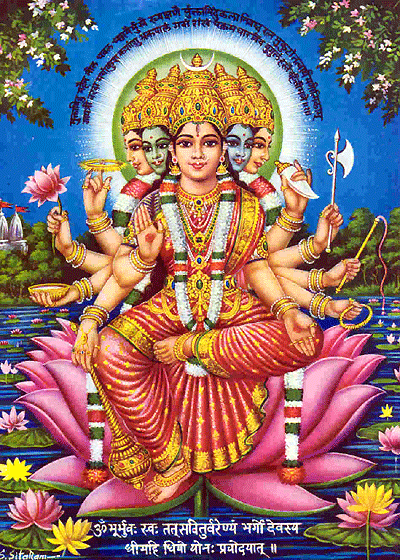
says, "Oh Uddhava, the Gayatri hymn is the bedrock
of all hymns." All means many. That in virtue of
which this number comes to be experienced is
Gayatri. The tri-syllabic A+U+M [OM] means
Omkar, The Logos. The next step starts with two
numbers. The first one is the consciousness of
one's own being. It is the natural characteristic,
the unuttered word. It is the unknowingly spoken
word given out everywhere and every moment and no
one knows about it. This word, uttered unawares, is
the Gayatri hymn, the basis of all hymns.
Innumerable words are spoken subsequently; and all
the universes spring from them, but the prime
Source of all is the Gayatri chhanda, the unspoken
word, the unuttered sound. Everyone has the same
experience, and what is the experience born of this
unspoken word? One's own being. [The Gayatri
hymn is composed of a metre consisting of 24
syllables – generally arranged in a triplet of
eight syllables each. Therefore, this particular
meter is also known as the Gayatri meter or Gayatri
chhanda.]
There are innumerable varieties of being from the
ant to the gods, but what is the original being? It
is Gayatri. The experience of this being is one's
own being. This Gayatri chhanda comes first, the
rest only follows. The characteristic of that being
is explained by the Lord as follows: "What is the
nature of that hymn? Even though there is the power
to create innumerable universes, it cannot be left
hold of." The original sound of the unasked for,
unspoken, unthought of and unuttered word was born
in the form of Chakrapani [diety] and it is
unique to Him; but not recognising it, the Perfect
has come to be a deplorable creature through graded
degeneration in the course of the temporal
process.
|
|
|
The pursuit of
the chhanda is fascinating. For everyone, it is the
same awareness of being, the unspoken word, yet
spoken. In spite of the efforts of the four
Vedas, six Shastras and eighteen
Puranas, its interpretation remains
incomplete? Still there is the uninterrupted
fascination for the Gayatri chhanda.
What does Gayatri chhanda mean? It is the awareness
of your own being, it is whatever you understand
without speech. Wherever there is life, there is
the hymn to support it. It vibrates in us, and in
spite of years of miserable drudgery, we do not
feel like parting with it. In virtue of this
Gayatri hymn, Sri Rama and Sri Vishnu came to this
earth as incarnations, but they mastered it. This
unwitting consciousness of your own being is the
same in us and in them, but they did it consciously
and experienced it as such. Other beings get only
to the surface of the meaning, which is only a
perversion thereof; the yawning of the creatures
lets out the syllables A+U+M.
Meditate on the meaning as you have understood
above. You are Chakrapani, the being with a
thousand hands and heads, the unuttered sound. The
word and its resounding sense are the first Person,
and are experienced as such. The sign of the
experience is complete satisfaction of the mind.
Gayatri hymn is the substratum of the satisfaction
of all and it bursts forth spontaneously, for the
sound is ever glorious. The name that resounds in
you without being uttered is your own indwelling
spirit.
It is enough if you silently listen to the ten
sounds, five resoundings, dual reverberation and
the single voice, and the symphony of them all.
This basic Gayatri hymn is with you only.
Three groups of eight syllables make one series of
24 sounds. The Gayatri hymn consists of 24
syllables as follows: OM, Bhur, OM, Bhuvah, OM,
Swah, OM, Mahah, OM, Janah, OM, Tapah, OM, Satyam,
OM, Tat, Savitur, Varenyam, Bhargo, Devasya,
Dhimahi, Dhiyo, Yo, Nah, Prachodayat. Great rishis
and saints acquire immense power by reciting this
hymn of 24 syllables. Innumerable worlds are
created and destroyed by its power, but consider
the power of the bisyllabic word Rama that easily
cancels all this power and rests in Perfection.
VEDAS AS BASIC: They were basic to
the subsequent interpretation, hence they are
called basic, but the primal root, first cause of
everything is this hymn.
THE BEATITUDE OF BRAHMAN: The experience of
one's own being, of the vision of one's own Self
and the eventual peace that is unparalleled is
called Brahmananda. The experience of one's own
nature without the help of others is later on
interpreted as the Great Beatitude
[Paramananda].
SPIRITUAL LIFE: Just as there is the luster
of luster, so also is Gayatri chhanda the very life
of spirit. The Lord says, "I am hidden and it is My
treasure, but that which hides Me also reveals Me.
How do I appear when seen? Surely as non-dual,
non-different. He who listens to the vibrating hymn
is hidden. With the devout recitation of this hymn
everything will be distinctly clear, for It is
already there; but if one wishes to realise My
vision without it, he will have It, and It will be
advaita, non-dual." [The reference is to nama
yoga as an easy alternative to dhyana or raja
yoga.] What do the syllables of this immovable
hymn signify? Absolute bliss of the Self; it is sat
[being], chit [consciousness], and
ananda [beatitude]. This is the essence of
the Gayatri hymn. Its contemplation confers
absolute bliss.
|
top
of the page
mentions
légales
2024

InnerQuest
| B.P.
29
| 75860
Paris cedex 18
| France
| +33
(0)1 42 58 79 82
| contact@inner-quest.org